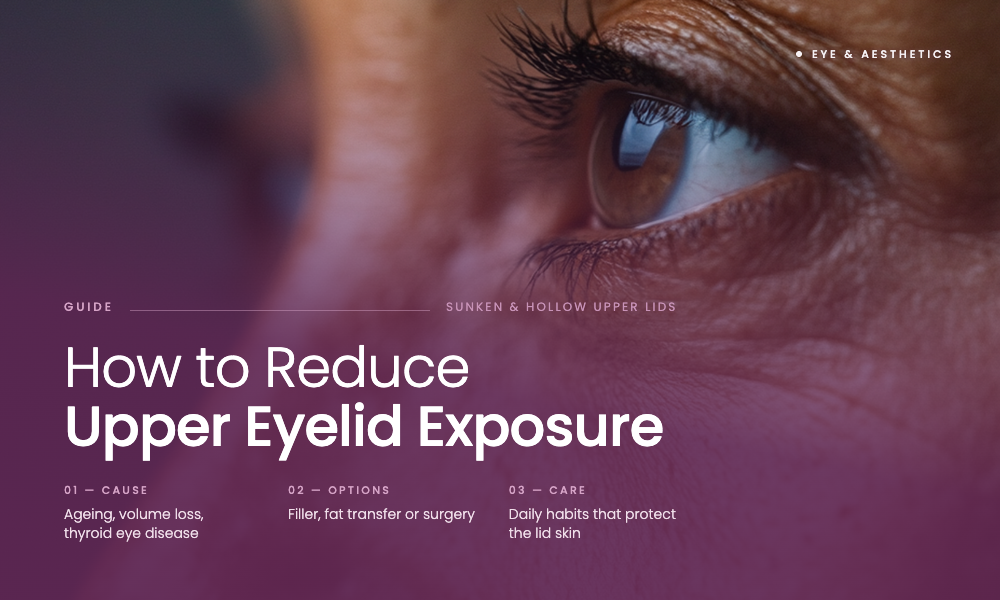
If you are wondering how to correct upper eyelid exposure, the truth is that you should first address the cause. In most cases, this entails restoring your lost volume using filler injections or fat transfer. On the other hand, some people need to address eyelid retraction caused by their thyroid gland before they can proceed with their daily routine.
Upper eyelid exposure just refers to having a large section of your lid showing from between your lash line and your eyebrows. You could have been born with this problem. Or maybe you noticed this occurring over time due to weight loss, an illness, or even normal ageing. Let this guide take you through all the causes, solutions, and signs that require consultation with an eye doctor.
Key Takeaways
- Upper eyelid exposure means more of the lid is on show than usual between the lashes and the brow.
- Ageing, volume loss, rapid weight loss, genetics and thyroid eye disease are the usual suspects.
- Both dermal fillers and fat transfer will help restore volume above the eyelid.
- Medical treatment for retraction associated with thyroid problems comes first before any cosmetic procedures.
How to Reduce Upper Eyelid Exposure
There isn’t any one treatment that works for every eye, and those who say otherwise have something to sell you. It depends on what has made the eyelid protrude too much. The typical approach is to go through four stages:
- Find the cause. A doctor examines the lids, measures their position, and checks the health of the eye itself.
- Treat any medical condition first. Thyroid eye disease, in particular, needs proper care before any cosmetic step.
- Rebuild the lost volume. Dermal filler or fat transfer can soften a hollow upper lid.
- Look after the skin. Simple daily habits protect the delicate eye area and help results last longer.
Each step gets its own section below.
Causes of Upper Eyelid Exposure
A few different things decide how much lid you see, and plenty of people have two or three going on at once.
Ageing and Volume Loss
Sunken upper eyelids top the list. A small pad of fat sits above each eye, keeping the area soft and full, a bit like padding under a bedsheet. That pad shrinks with age.
As it fades, the skin settles back against the bone and a deep groove forms beneath the brow. The lid looks bigger, darker, more hollowed out. Thinning skin makes the shadows harsher still.
Deep-Set Eyes and Genetics
Deep-set eyes sit further back in the socket, so the brow bone casts a shadow and more lid stays visible. It runs in families. It isn’t an illness, and plenty of people with this eye shape never want or need treatment.
Thyroid Eye Disease and Eyelid Retraction
But there is one exception: the condition known as thyroid eye disease. It is when the body’s immune system turns against the muscles and fat behind the eyes, causing the upper eyelid to be pulled back,k resulting in the startled look.

Eyelid retraction treatment begins with the thyroid itself, through medical care and regular specialist reviews. An ophthalmologist who manages eye conditions will closely monitor the lids and protect the eye’s surface while the disease settles.
Rapid Weight Loss
Fat loss is not limited to other parts of the body alone. If you want to shed those extra pounds, expect fat loss around your eye area too.
Previous Surgery or Injury
Older styles of eyelid surgery sometimes took out too much fat, and the upper lid can look scooped out years down the line. A knock or injury near the eye can leave a similar hollow.
How Treatment Works
Safe and effective treatment always begins with an assessment, not a product. You should expect your specialist to:
- Take a detailed patient history, focusing on thyroid function and prior eye surgery.
- Evaluate where each lid sits and how well they close.
- Inspect the front surface of the eye and tear film.
- Tailor the treatment plan to the underlying cause of the problem and outline risks as well as potential benefits.
No clinic can guarantee any result, and the ones that do are not being truthful with you. Careful planning around the eyes is crucial for safety.
Hollow Upper Eyelids Treatment Options
Hollow upper eyelids treatment works in one of two directions: restore soft volume above the eye, or bring an over-raised lid back down to where it belongs. Here are the main options.
Upper Eyelid Filler
Upper eyelid filler is a process by which a little bit of soft hyaluronic acid gel is injected into the hollow in the upper lid. This acid is naturally found in the skin; the gel only replaces the volume lost due to the fat pad’s reduction. Small amounts are injected at a time since less is more in this case.
Results show quickly and often hold for around a year, though that varies a lot between people. The gel isn’t permanent, and a clinician can adjust or dissolve it later if needed. Expect some swelling and bruising, and occasionally a small lump. Rare but serious problems can involve the blood vessels near the eye, which is exactly why only an experienced medical professional should treat this area.
Fat Transfer
Fat transfer takes a small amount of your own fat, usually from the tummy or thighs, and moves it into the hollow of the upper lid. Your own tissue tends to feel natural and can last for years. The catch: some of the fat absorbs in the first few months, so a top-up session is sometimes on the cards. Swelling, bruising and uneven settling are all possible, as with any procedure.
Surgery for Eyelid Retraction
If thyroid disease or prior surgery causes eyelid retraction, an oculoplastic surgeon can perform a procedure to reduce eyelid elevation. This involves detaching the muscles that control the eyelid so that it droops low enough to cover the eye. Usually, the procedure is performed once the underlying cause of the condition has stabilised. Possible complications include swelling and asymmetry, among others.
Skin Support Treatments
Laser resurfacing, microneedling and medical-grade skincare all improve the quality of the skin around the eyes. Fine lines soften. The skin thickens a little over time. What these treatments can’t do is rebuild lost volume, so specialists pair them with the options above rather than swapping them in.
Daily Habits That Support the Eye Area
Routine maintenance will not restore your fat loss. The good thing about it is that it will take care of your skin and enhance the appearance of any product used:
- Get at least 7-9 hours of sleep and maintain consistency.
- Stay hydrated but do not go for crash diets.
- Use sunscreen every day and wear sunglasses. Eyelid skin is the thinnest in your body.
- Do not rub your eyes, and treat allergies that cause you to rub them.
- Go for an eye cream rather than a stronger product.
- Apply a matte eyeshadow just above your crease.
Small habits stack up. They keep the skin healthy while you weigh up whether treatment is right for you.
When to See a Specialist
Book a medical review, not a cosmetic appointment, if any of these ring true:
- The change came on fast, or affects one eye only
- White shows above the coloured part of the eye
- The eyes feel dry, gritty or sore
- The lids don’t close fully when you blink or sleep
- The eyes appear to bulge forward
- Your vision has changed
Signs like these can point to thyroid eye disease or another condition that needs treating properly before anyone reaches for a cosmetic fix.
Conclusion
But how can one limit exposure of the upper eyelid? One must identify the cause and address it, whether it is a medical problem, and then build up the volume using either dermal fillers or fat injections, along with good lifestyle practices. It is a sensitive area that needs expert intervention throughout the process.
Anyone weighing up treatment for hollow or exposed upper lids can speak with Dr Kalin Tanov, a GMC-registered consultant ophthalmic surgeon at Dr Tanov Eye & Aesthetics in London and Newcastle. Book an eyelid consultation for a clear, honest plan.
FAQs
Are deep-set eyes the same as upper eyelid exposure?
No, deep-set eyes indicate where the eye is located in the socket, and this location often results in more lid show. Upper eyelid exposure refers to the lid being exposed itself, not necessarily to its causes.
Can you reduce upper eyelid exposure without surgery?
In most cases, yes. Filler injection adds volume without going under the knife, while your lifestyle will take care of your skin. Eyelid retraction caused by thyroid disorders will initially require non-surgical treatment.
How long does upper eyelid filler last?
Somewhere between nine and eighteen months, on average. This is because the body gradually absorbs the gel, so follow-up sessions are necessary to maintain the effect.
Does upper eyelid exposure get worse with age?
Normally yes, since the fat pad above the eyes continually shrinks, while the skin becomes increasingly thin, causing a deeper appearance. Protection from the sun and good habits will keep this trend at bay.
Is upper eyelid exposure a medical problem?
Generally no, but it is when there is excess lifting of the lid, drying of the eye, or inability to close the eyes completely.
Can makeup reduce the look of upper eyelid exposure?
For the day, yes. A matte shadow just above the crease creates a soft hooded effect, and lighter shades on the lid take the edge off the shadowing. It washes off at night, which suits anyone who wants no treatment at all.