It depends on the starting point of your sagging skin. A brow lift procedure lifts drooping eyebrows and smoothes the forehead. Blepharoplasty is a surgical procedure that removes excess skin and fat around the eyes.
Many people assume their eyelids are the issue when a low brow is the real cause. Pick the wrong procedure and the heaviness stays. This guide explains how each surgery works, what causes heavy lids and low brows, and the simple checks surgeons use to tell the two apart.
Key Takeaways
- A brow lift is used to elevate drooping brows and to smooth forehead lines
- The purpose of blepharoplasty is to remove excess skin and fat from the eye area
- Drooping brows can appear like hooded eyelids; therefore, the decision to perform either a brow lift or blepharoplasty is based on the reason
- There are some cases where both surgeries have to be done at once
Brow Lift vs Blepharoplasty: How Each Procedure Works
People often search for this choice as an eyebrow lift vs eyelid lift. Surgeons use the terms “brow lift” and “blepharoplasty”. Each one targets a separate part of the upper face. Hence, it helps to understand the difference between a brow lift and blepharoplasty by considering what each operation actually does.
What a Brow Lift Does
A brow lift is a surgical procedure that involves manipulating forehead tissues. In such an operation, the surgeon lifts the eyebrows into their normal position. The most recent methods leave the incisions small and well-concealed:
- Endoscopic brow lift: Incisions are made at the back of the hairline; a small camera assists the surgeon in raising the eyebrows underneath the skin.
- Temporal brow lift: Incisions are made in the hair on the temples to raise only the tail end of the eyebrows.
A brow lift is recommended for people with droopy eyebrows or deep furrows across the forehead or between the eyebrows.
What Blepharoplasty Does
Blepharoplasty, also called eyelid surgery, treats the eyelids only. For the upper lid, the surgeon makes a fine incision along the natural crease and removes a measured amount of loose skin, sometimes along with small pockets of fat. For the lower lid, the cut sits just under the lashes or inside the lid to remove or reposition the fat that forms under-eye bags.
Blepharoplasty suits people with loose eyelid skin, puffy under-eye bags, or heavy skin that blocks their side vision. If you wonder how to qualify for eyelid surgery, a surgical assessment gives the clearest answer.
A drooping eyelid edge, known as ptosis, is a separate condition. It involves the muscle that lifts the lid, so it needs ptosis surgery rather than skin removal.

What Is the Difference Between Brow Lift and Blepharoplasty?
The core difference between brow lift and blepharoplasty is the target area. A brow lift treats the frame around the eyes. Blepharoplasty treats the eyelids inside that frame.
The two areas affect each other, and that overlap is where the confusion between a brow lift and blepharoplasty starts. When brows drop, they push excess skin down over the eyelids, making the eyes look hooded. In that case, removing eyelid skin alone does not solve the problem. It can even pull low brows lower, making the eyes look heavy. This is why surgeons check brow position first in every brow lift vs blepharoplasty assessment.
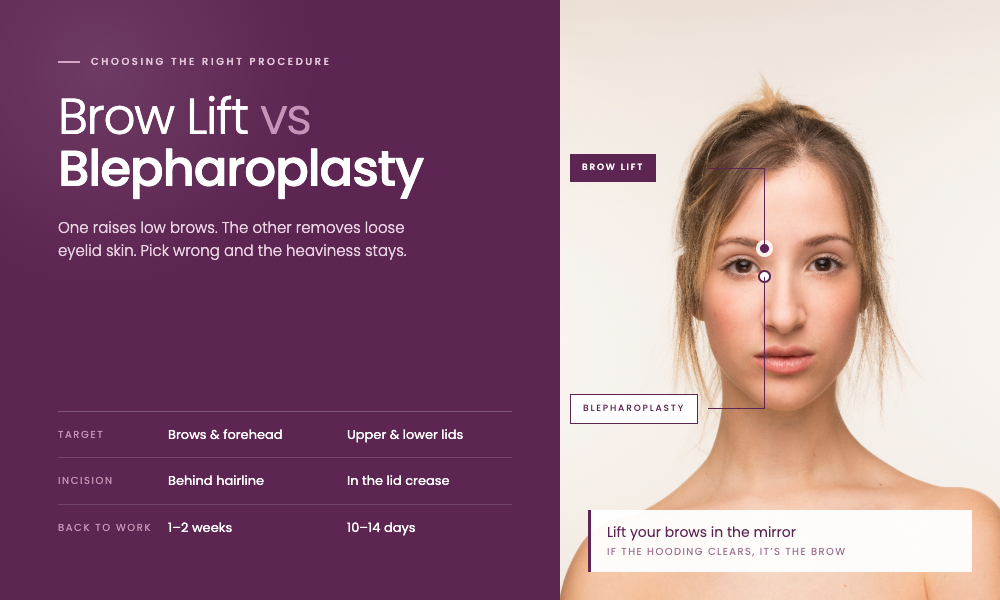
| Feature | Brow Lift | Blepharoplasty |
| Target area | Eyebrows and forehead | Upper and lower eyelids |
| Main goal | Raise low brows and smooth forehead lines | Remove loose eyelid skin and fat |
| Cut placement | Behind or along the hairline | Hidden in the natural eyelid crease |
| Anaesthetic | Local anaesthetic or light sedation | Usually local anaesthetic |
| Back to work | Around 1 to 2 weeks | Around 10 to 14 days |
| Results | Long-lasting | Long-lasting |
What Causes Heavy Brows and Hooded Eyelids?
The skin around the eyes is thin, so it shows change earlier than the rest of the face. Common causes include:
- Natural ageing: Collagen levels fall over time, so skin loses firmness.
- Loss of elasticity: The skin becomes stretched and does not return to its original position, causing drooping brows and lids.
- Genetic predisposition: The condition is usually inherited from one’s family members.
- UV rays: They deteriorate the collagen in the skin.
- Repeated muscle movement: Years of raising the brows etch deep lines into the forehead.
These changes build slowly, and the brow and eyelids often sag together. That shared cause is why the brow lift vs blepharoplasty question rarely has a one-size answer.
Do I Need a Brow Lift or Eyelid Surgery?
Many patients ask their surgeon, do I need a brow lift or eyelid surgery, and the answer depends on where the sagging starts. The decision between a brow lift and eyelid surgery follows a few clear signs.
Signs a Brow Lift May Help
- Your eyebrows sit at or below the bony rim above your eyes
- Deep horizontal lines cross your forehead
- The outer corners of your eyes look pulled down
- The hooding clears when you gently lift your brows with your fingers
Signs Eyelid Surgery May Help
- Your brows sit in a natural position, yet loose skin folds over the lid crease.
- Skin rests on your lashes or blocks your upper side vision
- You have puffy bags under your eyes
- You can still pinch loose lid skin while holding your brows in place
A Simple Mirror Check
Surgeons call this the manual elevation test, and it starts the upper blepharoplasty vs brow lift conversation. Relax your face in front of a mirror. Place your fingers above your eyebrows and lift them naturally. If the hooding disappears, brow position drives the problem. If a fold of loose skin remains on the lid, blepharoplasty treats that skin directly. Only a clinical assessment confirms the answer, because a surgeon measures brow position, skin stretch and vision before settling the brow lift vs blepharoplasty decision.
Can You Have a Brow Lift and Blepharoplasty Together?
Yes. In the brow lift vs blepharoplasty debate, the answer is sometimes both. Surgeons often perform a brow lift and blepharoplasty together, because the brow and the eyelid act as one unit. Combining them offers real advantages:
- One recovery period: You heal from both procedures at the same time instead of booking two separate breaks.
- A balanced result: Lifting the brow first allows the surgeon to remove less eyelid skin, keeping the eyes looking natural.
- A complete refresh: The whole upper third of the face changes together, so nothing looks out of step.
A surgeon confirms suitability for combined treatment at the assessment stage, since not everyone weighing brow lift vs blepharoplasty needs both.
Recovery, Results and Risks
Downtime is one of the practical differences in the brow lift vs blepharoplasty comparison, and honest expectations make recovery easier.
Recovery Timelines
After blepharoplasty:
- Swelling and bruising will be highest after 48 hours
- Cooling pads and elevating the head help reduce swelling
- The surgeon removes fine sutures in 5-7 days
- The majority of people go back to work in 10-14 days
After a brow lift:
- Feeling tension on the forehead in a matter of weeks is perfectly normal.
- Sleeping in a head-up position prevents fluid accumulation.
- Sutures and staples removal takes place in 7 to 10 days.
- Individuals usually feel socially confident within 1 to 2 weeks and abstain from exercise for 4 to 6 weeks.
What About Risks?
Every operation carries some risk, and a responsible clinic explains this openly. Temporary swelling, bruising and dry or light-sensitive eyes can follow blepharoplasty. Temporary numbness near the hairline can follow a brow lift. Infection, uneven healing and nerve irritation remain rare. Whichever side of the brow lift vs blepharoplasty decision you make, choosing an experienced, GMC-registered surgeon who understands the anatomy of the eye area reduces these risks. Results from both procedures are long-lasting, although natural ageing continues.
Brow Lift vs Blepharoplasty: The Bottom Line
To solve the dilemma of brow lift versus blepharoplasty, look in the mirror. Go for a brow lift if you have droopy eyebrows that pull down the skin over the eyes. Go for blepharoplasty if you have good brows but sagging skin around the eyelids. A combination may be needed if all the upper face is sagging.
A clinical assessment settles the question properly. Dr Kalin Tanov, a Consultant Ophthalmic Surgeon, provides brow lift surgery and upper blepharoplasty in London and Newcastle, and can assess which option suits your eyes.
FAQs
1. Which helps hooded eyes more in the brow lift vs blepharoplasty choice?
It all depends on the underlying reason. If the brows lower the skin above the lid, then the lift will fix the problem. However, if the excess skin is found directly on the eyelid, blepharoplasty is used.
2. Can a brow lift replace eyelid surgery?
Yes, only if the hooded eyelid appearance is due to low brows. Between a brow lift and a blepharoplasty, the former raises the arch, while the latter helps remove loose skin around the eyes. Notably, many people with excess skin need blepharoplasty.
3. How long do the results last?
Both procedures provide long-lasting effects in the brow lift versus blepharoplasty debate. The face continues to age naturally and hence changes gradually, but the effect stays noticeable for a considerable period.
4. Do these procedures need a general anaesthetic?
No, blepharoplasty is generally performed under local anaesthesia, although in some cases light sedation may be required. This applies to brow lifts as well.
5. At what age do people have a brow lift or eyelid surgery?
There is no particular age limit. It depends on several factors, such as brow position, skin quality, and eyesight.