Hooded eyes and ptosis look similar, but they are not the same thing. With hooded eyes, the eyelid sits in the right place, and extra skin from the brow folds down over it. With ptosis, the eyelid itself drops lower than it should because the muscle that lifts it has weakened.
This difference matters. Hooded eyes are mostly a skin problem, so surgeons treat them by removing the extra skin. Ptosis is a muscle problem, so surgeons treat it by tightening or shortening the lifting muscle. The wrong operation will not fix the right problem.
Many people have both at the same time, which is why a proper eye examination comes first. This guide explains hooded eyes vs ptosis in plain terms, so you know what to look for and what to ask about.
Key Takeaways
- Hooded eyelids are characterised by excess skin above a normally positioned eyelid.
- Ptosis is when the eyelid edge is lower than normal.
- The surgical correction for hooded eyelids differs from that for ptosis.
- A qualified ophthalmologist can distinguish between the two in a single examination.
Hooded Eyelids and Ptosis: What Sets Them Apart
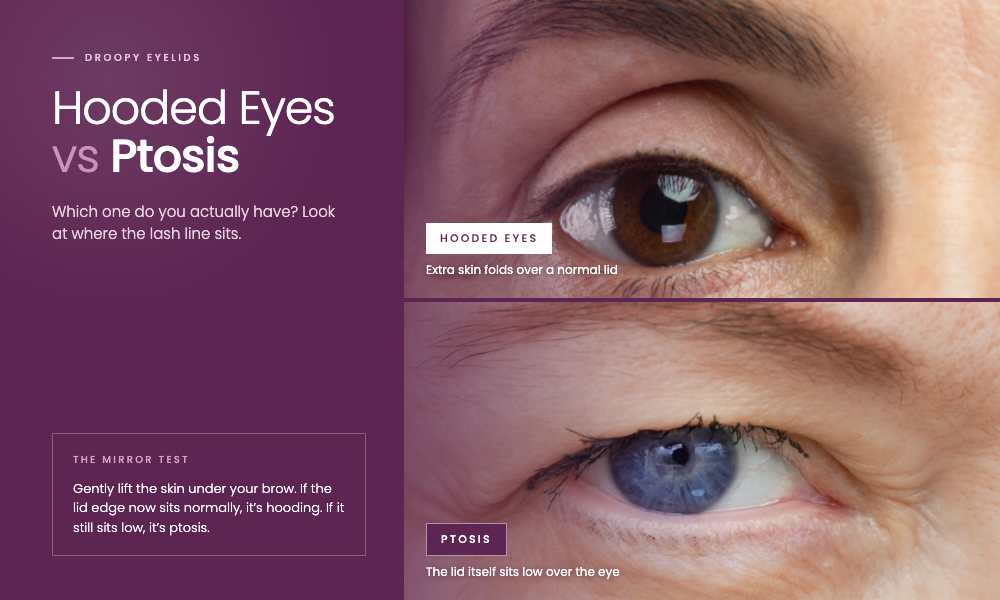
The quickest way to settle hooded eyes vs ptosis is to look at the edge of the upper eyelid, where the lashes grow. This edge is called the eyelid margin.
- Hooded eyes: The lash line sits in a normal position, just above the coloured part of the eye. Loose skin from under the brow hangs down and covers the crease, and sometimes the lashes too.
- Ptosis: The lash line itself sits lower than normal. It may cover the top of the coloured part of the eye, or even part of the pupil. There may or may not be extra skin.
Doctors call hooded eyes dermatochalasis. They call a true drooping lid blepharoptosis, or ptosis for short. Both can make you look tired, but the cause and the fix are different.
Hooded Eyes vs Ptosis at a Glance
| Hooded Eyes | Ptosis | |
| What it is | Extra skin above a normally placed eyelid | The eyelid itself sits too low over the eye |
| Medical name | Dermatochalasis | Blepharoptosis |
| Root cause | Loose skin and soft tissue (skin problem) | Weak or stretched lifting muscle (muscle problem) |
| Lash line position | Normal | Lower than normal, may cover part of the pupil |
| One or both eyes | Usually both | Often one, can be both |
| Main causes | Genetics, ageing, brow descent, sun damage | Age-related tendon stretch, present from birth, contact lens wear, eye surgery, nerve or muscle conditions |
| Effect on vision | Mild narrowing of upper side vision in heavy cases | Can block the upper field of vision, sometimes significantly |
| Home test | Lid edge sits normally once you lift the skin | Lid edge still sits low after lifting the skin |
| Treatment | Upper blepharoplasty (skin removal) | Ptosis surgery (muscle repair) |
| Non-surgical options | Skin-tightening laser for mild cases | None that tighten the muscle |
| Urgency | Not urgent | Sudden or fast-changing droop needs urgent review |
A Simple Test You Can Try at Home
Stand in front of a mirror and gently lift the loose skin above your eye with one finger. Do not pull on the lid itself.
- If the eyelid edge now sits in a normal spot, extra skin was the problem. That points to hooded eyes.
- If the eyelid edge still sits low over the eye, the lid itself is drooping. That points to ptosis.
This hooded eyes vs ptosis test gives only a rough idea. A specialist will measure the lid position properly during a consultation.
Droopy Eyelid Causes: Hooded Eyes vs Ptosis
The two conditions share some droopy eyelid causes, but each has its own main drivers.
Common Causes of Hooded Eyes
- Genetics: Some families simply have this eyelid shape.
- Ageing: Skin becomes less elastic as collagen and elastin production declines.
- Descent of the brow: With ageing, the forehead and brow area sink lower, pulling skin over the eye.
- Sun exposure: Increases loss of skin elasticity.
- Weight changes and swelling: Loose or puffy tissue can add to the hood.
Common Causes of Ptosis
- Age-related stretching: The levator tendon slips or thins. This is the most common cause in adults.
- Congenital ptosis: The muscle fails to develop completely before birth.
- Wearing contact lenses: Tugging on the eyelid for years stretches the muscle tendon.
- Previous eye surgery or injury: Operations such as cataract surgery can occasionally stretch the tendon.
- Nerve or muscle conditions: Problems such as myasthenia gravis, third nerve palsy or Horner’s syndrome can cause drooping. These need urgent medical review.
If you are unsure whether a brow lift or blepharoplasty suits you, the cause of the droop usually decides.
Symptoms: How Each Condition Feels and Looks
Both conditions can cause a heavy, tired look. When comparing hooded eyes vs ptosis, the smaller details tell them apart.

Symptoms of Hooded Eyes
- Folds over the eyelid crease
- The lashes become weighed down by the skin
- Eye make-up becomes smudged or vanishes inside the fold
- The eyes look small or drowsy
- Narrowing of the field of vision above
Symptoms of Ptosis
- Eyelid edge sits low, sometimes covering part of the pupil
- One eye looks smaller than the other
- Raising the eyebrows all day to see better
- Forehead lines and tension headaches from brow lifting
- Tilting the head back to look under the lid
- Eye strain, especially when reading or driving
How the Diagnosis Works
A specialist eye examination is the only reliable way to tell hooded eyes apart from droopy eyelids. The consultant will:
- Measure the lid position. They check how far the eyelid edge sits from the centre of the pupil. A normal gap is around 4 to 5 millimetres. A smaller gap suggests ptosis.
- Test the lifting muscle. They hold the brow still and ask you to look down, then up. The distance the lid travels shows how strong the levator muscle is.
- Check for extra skin. They lift the hood to see whether the lid margin sits normally underneath.
- Look for hidden causes. They check pupil size, eye movement and muscle fatigue to rule out nerve or muscle disorders.
- Assess your vision. A visual field test can show whether the lid is blocking part of your sight.
This process takes minutes, but it decides which operation, if any, will help.
Treatment Options for Hooded Eyes and Ptosis
The right treatment for hooded eyes vs ptosis depends on what the examination finds. Some people need one procedure. Some need both in the same operation.
Hooded Eyes Treatment
The main treatment for hooded eyes is an upper eyelid lift, also known as hooded eyelids surgery or upper blepharoplasty. The surgeon:
- Makes a small cut hidden in the natural eyelid crease
- Removes the extra skin, and sometimes a little fat or muscle
- Closes the cut with very fine stitches
The operation usually takes 45 to 90 minutes under local anaesthetic, with or without light sedation. Most people return to work within one to two weeks. Results often last around ten years. Upper blepharoplasty suits people whose eyelid margin sits normally once the extra skin is lifted.
For very mild hooding, a non-surgical CO2 laser treatment can tighten the skin without cutting. It doesn’t remove skin, so it helps only for slight hooding.
Ptosis Surgery UK: How It Works
Ptosis surgery repairs the muscle, not the skin. The surgeon:
- Makes a small cut in the eyelid crease, or works from the inside of the lid
- Finds the levator muscle tendon and tightens, shortens or reattaches it
- Sets the lid at the correct height, often checking it during the operation
- Closes with fine stitches hidden in the crease
The procedure takes around 30 to 90 minutes under local or twilight anaesthetic. Downtime is usually one to two weeks. Ptosis surgery can restore the full field of vision when a drooping lid has been blocking it.
For ptosis with very weak muscle function, such as some congenital cases, the surgeon may use a different technique called a brow suspension. This links the lid to the forehead muscle so the brow lifts the lid.
When You Need Both
Many older adults over 50 have both a hooded eye and a stretched levator tendon. In such patients, both conditions can be addressed during one surgery. Addressing only the hooded area will leave the eyelid lower than normal, which is why a thorough examination matters.
What Recovery Looks Like
Recovery is similar for both procedures:
- Swelling and bruising peak in the first three days and settle over one to two weeks
- Stitches come out after about a week
- Cold compresses and sleeping with your head raised help
- Avoid heavy exercise, swimming and eye make-up for around two weeks
- Final results show once all swelling has gone, usually within a few months
Risks to Know About
Every eyelid operation carries some risk. The consultant will explain these before you decide. They include:
- Swelling, bruising and temporary dry or gritty eyes
- Asymmetry between the two lids, which may need a small adjustment
- Over- or under-correction of lid height in ptosis surgery
- Infection, bleeding or scarring, which are rare
- Difficulty fully closing the eye, usually temporary
Choosing a surgeon who understands eye anatomy, not just skin, lowers these risks.
Can You Treat Either Condition Without Surgery?
Non-surgical options are limited. For hooded eyes:
- Laser treatments can be used for mild cases
- Makeup tricks can enhance the appearance
- Protection against the sun will stop loosening of the skin
For ptosis, no cream, exercise, or any other non-surgical method can make a loose tendon contract. If a nerve problem or muscle weakness causes ptosis, you can treat the cause. Otherwise, surgery is the only option.
Conclusion
Hooded eyes vs ptosis depends on one question: does the eyelid sit in the correct position with excess skin, or does the lid itself sit too low? Hooded eyes require skin removal, while ptosis requires repair of the lid’s elevating muscles. Some people may require both.
If you want a clear answer about your own eyelids, the consultant ophthalmic surgeon at Dr Tanov Eye & Aesthetics offers blepharoplasty and ptosis surgery in London and Newcastle, and assesses every case for eye safety before planning any operation.
Frequently Asked Questions
How do I know if I have ptosis or hooded eyes?
Look at where your lash line sits. If it rests in a normal spot above the coloured part of your eye but skin folds over it, you likely have hooded eyes. If the upper lash line itself sits low over the eye, that suggests ptosis. An eye specialist can confirm this by measuring your lid position.
Can ptosis go away on its own?
Age-related and congenital ptosis do not improve without treatment. Ptosis caused by a nerve or muscle disorder may improve if you treat the underlying condition. Any sudden new droop needs urgent medical review.
Is blepharoplasty the same as ptosis surgery?
No. Blepharoplasty removes extra skin and fat from the eyelid. Ptosis surgery tightens the muscle that lifts the lid. Surgeons often combine them when a patient has both problems, but they treat different things.
What happens if hooded eyes are left untreated?
Nothing harmful in most cases. The hood may slowly get heavier with age and can eventually narrow your upper field of vision. Some people find it affects makeup or causes a tired look, but it is not a medical danger.
Does ptosis surgery leave a scar?
The surgeon places the cut in the natural eyelid crease, where the fold hides it. Most scars fade to a faint line that is hard to see once healed.
Can hooded eyes cause headaches?
Yes, this happens in certain individuals. Ptosis and heavy hooding can make you raise your eyebrows throughout the day to see clearly, and this constant forehead work can cause headaches at the end of the day.