Day-by-day eyelid surgery recovery-time photos show a clear pattern. Swelling and bruising build over the first two to three days, ease through the first week, and fade steadily after that. Most people feel ready for work and social plans within one to two weeks, although subtle changes carry on for months.
Understanding the typical eyelid surgery recovery time helps you read those photos properly. A puffy day-three picture is not a problem. It is a normal stage of healing. This guide walks you through what recovery photos usually show at each stage, what speeds healing, and when a photo suggests you should call your surgeon.
Key Takeaways
- The swelling will usually peak after the first two or three days, then subside.
- The visible bruising usually takes ten to fourteen days to disappear.
- Daily photographs will enable you to monitor the healing process.
- Complete recovery may take several weeks up to several months
What Day by Day Eyelid Surgery Recovery Photos Really Show
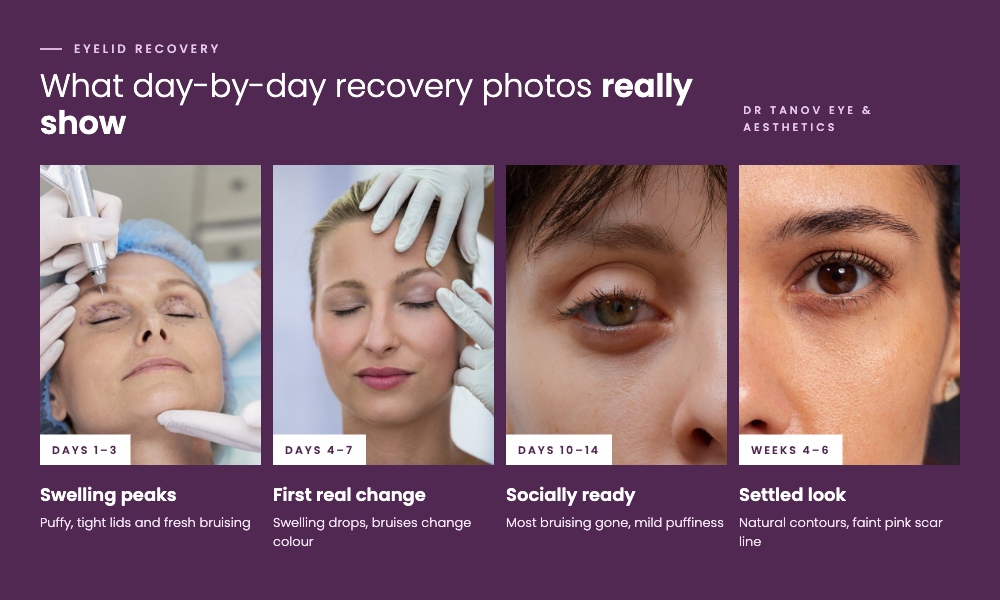
Recovery photos are a record of normal healing, not a preview of your final result. In the early days, the lids look swollen and tight, and the skin around the eyes changes colour as bruising develops and fades. None of this reflects how your eyes will look once everything settles.
Photos also vary a lot from person to person. Age, skin tone, whether you had one lid or both treated, and even the lighting in the room all change how a picture looks. Someone who had upper blepharoplasty alone may look calmer on day five than someone who had both upper and lower blepharoplasty.
The value of daily pictures lies in the trend. Healing photos should look a little better each day after the early peak. That steady direction matters far more than any single image.
Blepharoplasty Recovery Photos Day by Day: The First Week
Recovery pictures for a blepharoplasty will generally have the same progression pattern during week one. This is what each phase would look like.
Days 1 to 2: Swelling Starts
Puffiness of the eyelids, thin incisions that can be seen through the natural crease of the eyelid, and the skin being shiny are some of the things one can see in these pictures. Eyelid swelling and bruising typically appear at this time and are usually managed with cold compresses and elevating the head while sleeping.
Days 3 to 4: Worst Point
The worst part of swelling and bruising is when it peaks during days 2 to 3. The bruises may appear dark purple before turning green. Some people may experience blurred vision due to ointment or eye watering.
Day 5 to 7: The First Real Change
The recovery pictures at the end of the first week look much calmer. There has been a reduction in swelling, and the bruising is also decreasing. The dissolving stitches are not needed; stitches need to be removed during the fifth to seventh day.
Read More: Upper blepharoplasty before and after

Blepharoplasty Recovery Timeline: Week by Week
The wider blepharoplasty recovery timeline stretches well beyond the first week, and photos keep telling the story.
During week two, most bruising fades and swelling continues to decrease. Many people return to work and social plans between days ten and fourteen. Light makeup is usually possible once the incisions have fully closed, which often takes two to three weeks, so ask your surgeon before applying anything near the eyes.
Upper Blepharoplasty Recovery Photos at Each Stage
Photos after upper blepharoplasty surgery usually calm down somewhat more quickly than lower-lid photos because the upper eyelid crease camouflages the incision very effectively. Initially, the scar appears pink, then softens and lightens over the next several months. One of the reasons why many patients ask about the time to resume sleeping on one’s side after blepharoplasty surgery is the fact that the side on which one sleeps might appear somewhat puffier on morning photos.
Blepharoplasty Swelling Timeline
Blepharoplasty Swelling Timeline:
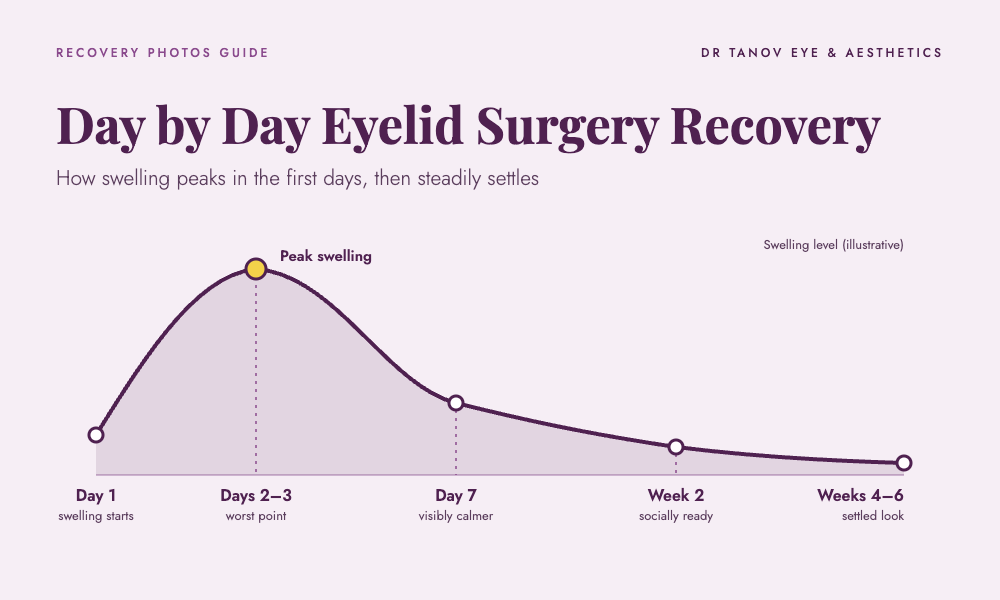
- Days 1-3: swelling increases and reaches its peak
- Days 4-7: the decrease becomes evident and is steady
- Days 8-28: some swelling left, usually more in the morning
- Months 1-3: final fullness dissipates
Morning photos might look puffier than evening photos during this time. Fluid accumulates around the eye area overnight, so the photos need to be compared from the same time period.
Eyelid Surgery Healing Stages: What Helps and What Slows You Down
The way you live every day will determine how quickly you recover from eyelid surgery.
Good habits for recovery are:
- Sleeping with your head raised for the first week
- Using cold compresses during the first 48 hours
- Keeping your hands away from your eyes
- Avoiding heavy lifting and exercise for one to two weeks
- Wearing glasses instead of contact lenses for around two weeks
- Protecting the area from strong sun
Things that slow healing include smoking, alcohol in the early days, and returning to strenuous activity too soon. Smokers in particular tend to heal more slowly, a point highlighted in NHS guidance on blepharoplasty. Following your surgeon’s aftercare instructions closely gives your photos the steady improvement you want to see.
How Long Does It Take to Recover from Eyelid Surgery?
One question many people ask before scheduling an appointment for eyelid surgery is how long recovery takes. Recovery normally happens in seven to fourteen days. Healing goes on without people being aware of it, and the scars continue to soften for several months, even up to one year.
| Stage | What photos usually show | Typical timing |
| Early swelling | Puffy, tight lids and fresh bruising | Days 1 to 3 |
| First improvement | Swelling drops, bruises change colour | Days 4 to 7 |
| Socially ready | Most bruising gone, mild puffiness | Days 10 to 14 |
| Settled look | Natural contours, faint pink scar line | Weeks 4 to 6 |
| Final result | Fully softened scars, settled shape | 3 to 12 months |
These timings vary between people. Age, general health, and whether one or both lids were treated all play a part, so treat the table as a guide rather than a promise.
How to Take Useful Recovery Photos at Home
Good photographs will help you evaluate your progress and give your surgeon something to work with.
Here is how you do it:
- Select the same location so the lighting is the same each time.
- Get front, two sides, and closed eyes.
- The camera should be placed on the same level as your eyes and without any filters.
- Take photos two times a day for the first week, once a day, then once a week.
- Make sure to date each picture or put it into a dated album.
- Consistency is key here, and it will help you see the real progress.
When to Contact Your Surgeon
Most photos simply show normal healing, but a few signs deserve a prompt call to your clinic:
- Pain that gets worse instead of better
- Spreading redness or heat around the incisions
- Discharge or bleeding that does not stop
- A sudden change in your vision
- One eye becoming much more swollen after the initial peak has passed
Serious problems after eyelid surgery are rare, and acting early keeps them manageable. Your surgeon would always rather see a photo too soon than too late.
Conclusion
Daily eyelid surgery recovery photos will be very informative once you understand what to look for. There is maximal swelling in the first two to three days after surgery; the most obvious difference is seen in the second week, and further nuances develop over several months.
Photos taken each day will make your uncertainty more predictable and allow you to track the process clearly. Also, you will have something useful to discuss during your check-ups, so your little doubts can be solved before they develop into concerns.
If hooded or heavy lids are on your mind, a consultation is the sensible first step. The experts at Dr Tanov Eye & Aesthetics provide consultant-led blepharoplasty in London and Newcastle, with honest advice on recovery from your first appointment to your final photo.
FAQs
How long does swelling last after eyelid surgery?
The majority of swelling disappears after two weeks. Some slight swelling in the morning may persist for another week or two.
When can I wear makeup after blepharoplasty?
Most surgeons advise waiting until the incisions have fully closed, which usually takes two to three weeks. Always confirm with your own surgeon first.
When do stitches come out after eyelid surgery?
Non-dissolvable stitches usually come out between five and seven days after surgery. Dissolvable stitches disappear on their own over a similar period.
Why do my eyes look uneven during recovery?
One side often swells more than the other or heals at a slightly different pace. This usually evens out as the swelling settles over the following weeks.
When can I exercise after blepharoplasty?
Gentle walking is fine within a few days. Most surgeons advise waiting 1 to 2 weeks before resuming heavier exercise, as elevated blood pressure can increase swelling.
How long until scars fade after eyelid surgery?
Scar lines sit within the natural crease and usually look pink for a few weeks. They soften and fade gradually over three to twelve months.
Do lower eyelids take longer to heal than upper eyelids?
Often, yes. Lower lid swelling can take a little longer to settle because fluid gathers more easily there, so photos of lower lids may lag a week or so behind.