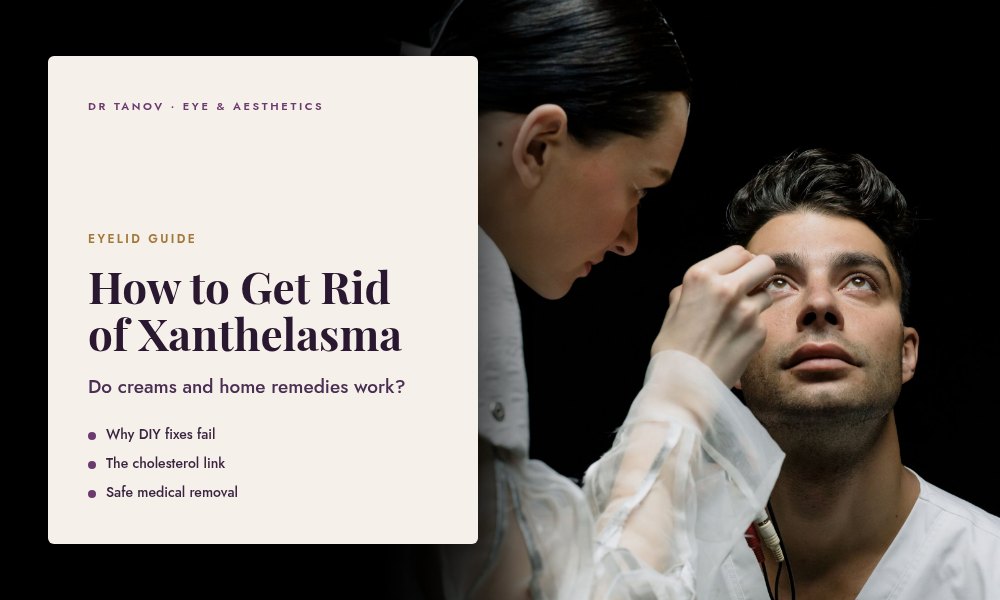
Xanthelasma are soft, yellow patches on or around your eyelids. They are made of fatty deposits, mostly cholesterol, that build up under the skin. They are harmless, but many people dislike how they look.
So, can a cream or home remedy get rid of them? The honest answer is no. No cream, oil or home remedy has been shown to remove xanthelasma. Some, such as garlic or strong acids, can burn the thin skin of your eyelids.
This guide explains what xanthelasma are, their link to cholesterol, why home remedies fail, and the medical options that work.
Key Takeaways
- Xanthelasma are yellow, cholesterol-rich patches on the eyelids, and they are harmless
- No cream or home remedy is proven to remove them, and some can burn your skin
- About half of people with xanthelasma have high cholesterol, so see your GP for a blood test
- Patches rarely go away on their own and may grow slowly
- A doctor can remove them with a laser or minor surgery, but they can come back
What Is Xanthelasma?
Xanthelasma is short for xanthelasma palpebrarum. The name comes from Greek and Latin words that mean ‘yellow plate’ on the eyelid. The patches often sit near the inner corner of the eye, on the upper or lower lid.
They are usually:
- Yellow or orange in colour
- Flat or slightly raised
- Soft to the touch
- Not sore or itchy
Once a patch forms, it tends to stay the same size or grow slowly. It rarely fades on its own. It doesn’t affect your sight, and you can’t squeeze it out like a spot.
Is It Xanthelasma or Something Else?
Other bumps can look similar. Milia are tiny, hard, white cysts, and some people mistake them for xanthelasma. Our page on milia removal explains more. A stye or cyst is usually red, swollen or sore. If a lump bleeds, changes quickly, or looks unusual, have a doctor check it.
What Causes Xanthelasma?
Xanthelasma forms when fat-filled cells collect in the skin of your eyelid. The exact cause is not fully known.
They are linked with high levels of fat in your blood, such as cholesterol. However, around half of people with xanthelasma have normal cholesterol, according to the American Academy of Ophthalmology. You are more likely to get them if you:
- Have high cholesterol, or it runs in your family
- Smoke
- Are overweight
- Have high blood pressure or diabetes
- Are middle-aged or older
Why Xanthelasma Can Be a Sign to Check Your Heart Health
This is the most important part. The patches are harmless, but they can clue you into your health.
A large Danish study in the BMJ followed nearly 13,000 people for up to 33 years. People with xanthelasma had a higher risk of heart attack and heart disease. This was true even after accounting for their cholesterol levels.
A later review of 15 studies found that people with xanthelasma had higher levels of ‘bad’ cholesterol, called LDL, than people without it.
Why a GP Blood Test Matters
The NHS lists yellow lumps or patches around the eyes as a reason to see your GP. High cholesterol usually doesn’t cause symptoms. You can only find out if you have it from a blood test.

Your GP may check your lipids, the fats in your blood, including cholesterol. They may also work out your risk of heart attack or stroke. If your levels are high, diet or medication changes can lower that risk.
Please don’t skip this step, even if you only want the patches gone for how they look.
Do Creams and Home Remedies Get Rid of Xanthelasma?
Online, you will find lots of creams and home remedies that claim to remove xanthelasma. None have good evidence behind them. A large review of xanthelasma treatments looked at 49 studies. The methods that worked were all medical, such as surgery, lasers, and doctor-administered treatments. Creams and home remedies were not among them.
Here’s what you need to know about the most common ones.
Garlic
Raw garlic contains a strong substance that can irritate and burn the skin. Doctors have reported chemical burns and blisters after people left crushed garlic on their skin as a home remedy. Your eyelid skin is much thinner than skin elsewhere, so the risk is higher.
Castor Oil and Tea Tree Oil
There is no proof that castor oil or tea tree oil can break down the cholesterol under your skin. Tea tree oil can also irritate the skin and cause an allergic rash. Keep oils away from your eyes, as they can sting and irritate them.
Apple Cider Vinegar and Iodine
Apple cider vinegar is an acid. Iodine is a strong antiseptic. Neither is proven to remove xanthelasma, and both can irritate or burn the delicate skin around your eyes. They can also harm your eye if they run into it.
TCA Kits and Acid Peels
TCA (trichloroacetic acid) is a strong acid. Some doctors use it in a careful, controlled way. Home kits are a different matter. Too much acid, or acid in the wrong place, can burn your eyelid, leave a scar, or cause light or dark patches. It can also damage your eye.
Xanthelasma Creams
Some creams claim to ‘dissolve’ cholesterol deposits. There is no good evidence that any cream works. Some contain acids or other strong ingredients that can irritate the skin. A cream also can’t reach the deposit, which sits under the skin.
Not sure what’s behind the yellow patches on your eyelids? A careful check of the patches and your eyelid health. Honest advice on whether removal suits you. A plan that protects the delicate skin around your eyes.
Does Lowering Your Cholesterol Make Xanthelasma Go Away?
Lowering high cholesterol is good for your heart and blood vessels. However, a healthy diet or cholesterol medicine usually has little or no effect on patches you already have.
Even so, managing your cholesterol still matters. It protects your health, and it may lower the chance of new patches after treatment.
What Medical Treatments Remove Xanthelasma?
A doctor can remove xanthelasma. The best method depends on the size, depth and position of the patches. Two proven options are a CO2 laser and minor surgery.
CO2 Laser
A CO2 laser uses a beam of light to remove the patch layer by layer. The review above found that CO2 laser was one of the most studied methods. In those studies, over 90% of patients saw more than 75% improvement. Laser often suits smaller, flatter patches. For more on how this laser works, read our guide to fractional CO2 laser.
Minor Surgery
Here, the doctor cuts out the patch and closes the skin with fine stitches. Surgery often suits larger or deeper patches. For very large patches, it can be combined with eyelid surgery.
| CO2 laser | Minor surgery | |
|---|---|---|
| How it works | Light removes the patch in thin layers | The patch is cut out and stitched |
| Often suits | Smaller, flatter patches | Larger or deeper patches |
| Anaesthetic | Local anaesthetic | Local anaesthetic |
| Main risks | Light or dark patches, scars | Scars, a change in lid shape |
Both are done under local anaesthetic, which numbs the area while you stay awake. The skin around your eyes is thin and close to your eye. So choose a doctor with experience in eyelid treatments.
What Is Recovery Like After Xanthelasma Removal?
Recovery is usually short. Here is what to expect:
- First few days: mild swelling, bruising and tenderness around the treated area.
- Week 1 to 2: a small scab or crust forms and then falls off. Don’t pick it.
- Weeks after: the skin may look pink for a while before it settles.
Many people return to desk work within a few days. Keep the area clean, use any ointment your doctor gives you and protect the skin from the sun.
What Are the Risks of Xanthelasma Removal?
Every treatment carries some risk. Most side effects settle with time.
Common Side Effects
- Swelling and bruising
- Redness or a scab while the skin heals
- Mild soreness
Less Common Risks
- Light or dark patches of skin, which the review found was the most common problem
- A visible scar
- Infection
- A change in the shape of the eyelid
- Patches that come back
Xanthelasma can return after any treatment, especially if your cholesterol stays high. So a removal fixes the patches you have now. It cannot promise that new ones won’t form.
Ready for clearer, smoother eyelids? Xanthelasma removal in London and Newcastle. Treatment by a Consultant Ophthalmic Surgeon. Clear advice on recovery and the chance of patches coming back.
Is Xanthelasma Removal Available on the NHS?
The NHS does not usually remove xanthelasma, as they are harmless and removal is seen as cosmetic. However, your GP can still check your cholesterol and heart health for free. Most people who want the patches removed choose a private clinic.
Private prices vary with the method and how many patches you have. Your exact price is confirmed at your consultation.
Conclusion
You can’t get rid of xanthelasma with creams or home remedies, and some can burn your eyelids. See your GP first for a cholesterol test, as the patches can be a sign to check your heart health. If you then want them gone, a doctor can remove them safely with a laser or minor surgery.
At Dr Tanov Eye & Aesthetics, Dr Kalin Tanov, a Consultant Ophthalmic Surgeon with over a decade of experience, offers xanthelasma removal in London and Newcastle. He can check your patches and eyelids and advise on the right method for you.
Frequently Asked Questions
Can xanthelasma go away on its own?
It’s rare. Most patches stay the same size or grow slowly over time. Lowering your cholesterol is good for your health, but it usually doesn’t make the patches you have fade.
What is the best home remedy for xanthelasma?
There isn’t one that works. No cream, oil or home remedy is proven to remove xanthelasma. Some, such as garlic or acid kits, can burn the thin skin of your eyelids.
Is xanthelasma a sign of high cholesterol?
It can be. About half of people with xanthelasma have high cholesterol, and the patches are linked with a higher risk of heart disease. Ask your GP for a blood test.
Can I remove xanthelasma at home with a needle?
No. Don’t try to cut, pop or burn a patch yourself. The deposit sits under the skin, and your eyelid is close to your eye. You could cause an infection, a scar or an eye injury.
Will xanthelasma come back after removal?
It can. Patches may return after any treatment, especially if your cholesterol stays high. Managing your cholesterol may lower the chance of new ones.
Does xanthelasma removal hurt?
Your doctor numbs the area with local anaesthetic first. Most people feel a small sting from the injection, then pressure. The area may feel sore for a few days after.
Does xanthelasma removal leave a scar?
There is a small risk of a scar or a change in skin colour. An experienced doctor chooses the method that suits your patches to keep this risk low.