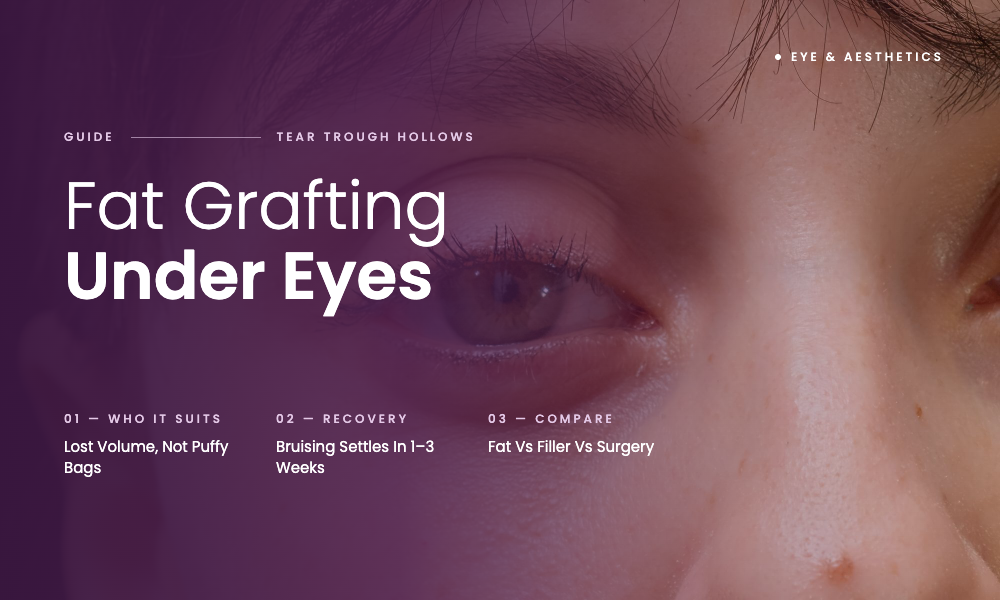
Fat grafting under eyes moves a small amount of your own fat into the hollows below your eyes. It can soften a deep groove and help you look less tired. However, it only helps when the problem is lost volume. It will not fix puffy bags, brown marks or loose skin.
So the first step is to find the real cause of the shadow. A hollow, a bag and a dark patch can look alike in the mirror. In fact, many people have more than one at the same time.
This guide explains how under-eye fat transfer works, who it suits, the risks and how it compares with filler and surgery.
Key Takeaways
- Fat grafting uses your own fat to fill hollows under the eyes
- It suits lost volume, not puffy eye bags or dark pigment
- Not all the fat survives, so a top-up is sometimes needed
- Bruises and swelling usually settle over one to three weeks
- An eye specialist should find the cause before you choose a treatment
What Is Fat Grafting Under the Eyes?
Fat grafting is also called fat transfer or lipofilling. A doctor takes a small amount of fat from another part of your body. The doctor then cleans the fat and places it under the eyes using a very fine tube.
The aim is to fill the groove between the lower lid and the cheek. Doctors call this groove the tear trough. When it is deep, it casts a shadow. That shadow can look like a dark circle, even after a full night of sleep.
What Types of Fat Graft Are There?
Doctors can prepare the fat in two main ways.
Micro Fat
Micro fat is fat in tiny pieces. It adds soft volume to a hollow, so it suits a deep tear trough.
Nano Fat
Nano fat is filtered much more finely and placed closer to the skin surface. Some doctors use it for thin, dull under-eye skin. However, research is still in the early stages.
What Causes Hollows Under the Eyes?
Hollows form when the soft fat pads under the eye shrink or drop. Common causes include:
- Age: your face loses fat and bone volume over time, so the groove gets deeper
- Genes: some people have deep-set eyes or flat cheeks from a young age
- Weight loss: fast or large weight loss can thin the face
- Thin skin: veins and muscle show through, which makes the area look darker
- Past surgery: older styles of eyelid surgery sometimes took out too much fat
Our guide to the types of dark circles explains how to tell a hollow shadow from pigment or visible veins.
How Can You Tell if Lost Volume Is the Problem?
Try this quick check at home. Stand under an overhead light and look straight into a mirror.

- If a groove casts a shadow below your lower lid, lost volume may be the cause.
- If a soft bulge sits above that groove, you may have eye bags. These form when fat pushes forward.
- If the skin looks brown or purple even in soft, even light, pigment or veins may play a part.
This check gives only a rough idea. That’s why a specialist exam should come before anyone adds volume.
How Does Under-Eye Fat Transfer Work?
At Dr Tanov Eye & Aesthetics, fat grafting takes place under local anaesthetic. This means you stay awake, but the areas are numb. The main steps are:
- Numb the areas. Your doctor numbs the donor site and your face.
- Collect the fat. A cannula, which is a thin, blunt tube, removes a small amount of fat. It usually comes from the outer thighs or tummy, through a cut about half a centimetre long.
- Prepare the fat. The fat is filtered to separate it from blood and fluid. It can then be made into microfat or nanofat.
- Place the fat. Tiny amounts go into the hollow in thin layers. This helps the result look smooth.
Only a small amount of fat goes under the eyes. However, the work is slow, because each tiny drop must sit in the right place.
Fat Grafting vs Filler vs Lower Blepharoplasty: Which Suits You?
Each option treats a different problem. This table shows the main differences.
| Fat grafting | Hyaluronic acid filler | Lower blepharoplasty | |
|---|---|---|---|
| What it is | Your own fat moved into the hollow | A soft gel injected into the hollow | Surgery to remove or move fat and tighten the lower lid |
| Best for | Hollows and wider volume loss | Mild to moderate hollows | Puffy bags, extra skin, or both |
| Anaesthetic | Local | A cream to numb the skin, or none | Local or twilight sedation, sometimes general |
| Time off | About one to two weeks | Often none, with possible bruises | About seven to ten days |
| How long it lasts | Fat that survives can last for years | Often several months to over a year | Many years |
| Can it be reversed? | Not easily | Yes, it can be dissolved | No |
| Main risks | Lumps, uneven fat survival, rare blood vessel blockage | Lumps, puffiness, rare blood vessel blockage | Swelling, dry eyes, change in lid position |
Some people need both surgery and fat. If bags are your main concern, read our guide on how to get rid of eye bags.
Who Is Suitable for Fat Grafting Under the Eyes?
You may suit this treatment if you:
- Have hollows or a deep tear trough from lost volume
- Want a result that lasts longer, with your own tissue
- Have enough spare fat to collect
- Have a stable weight
- Are in good general health and do not smoke, or can stop
- Accept that a top-up may be needed
Who Should Not Have It?
Fat grafting is not the right choice if you:
- Have puffy eye bags, because extra volume can make a bulge look bigger
- Have dark circles caused mainly by brown pigment
- Have a lot of loose skin on the lower lid
- Have an active eye or skin infection
- Are pregnant or breastfeeding
- Are under 18
- Expect a perfect or exact result
If you have thyroid eye disease or another eye condition, it needs medical care first.
What Are the Risks and Side Effects?
Every procedure carries some risk. The skin under the eye is the thinnest on the face, so even a small lump can show.
Common Side Effects
- Bruises and swelling under the eyes and at the donor site
- Soreness for a few days
- A slightly uneven look while the swelling settles
Less Common Risks
- Lumps or small bumps under the skin
- Too much or too little fullness
- Uneven fat survival between the two sides
- Small fat cysts
- Infection
Rare but Serious Risks
In rare cases, fat can enter a blood vessel. This can block blood flow to the eye or brain and cause loss of sight or a stroke. These events are very rare, but they matter. A review of lower eyelid fat grafting lists these and other complications. That’s why it matters to choose a doctor who knows the anatomy of the eye socket well.
Fat is also hard to remove once it settles. Unlike filler, you can’t dissolve it with an injection.
What Is Recovery Like?
Recovery is different for everyone. Here is a general guide:
- Days 1 to 3: swelling and bruises are at their worst. Cold packs help, and a raised pillow at night does too.
- Week 1: most visible swelling fades. Many people return to desk work within one to two weeks.
- Weeks 2 to 3: bruises fade for most people. Avoid hard exercise, saunas and pressure on your face.
- Months 1 to 3: the area settles, and the result becomes clearer.
- Months 3 to 6: the fat that will stay has now taken hold.
Your clinic will give you its own aftercare plan, which may include a short course of antibiotics. Follow it closely. Contact the clinic straight away if you notice severe pain, worsening swelling, a change in your vision, or signs of infection.
How Long Do the Results Last?
Fat needs a new blood supply to survive. Some of it does not get one, so your body clears it away in the first few months. The clinic expects around 50 to 70% of the grafted fat to stay. However, the exact amount varies from person to person. Your blood supply, lifestyle and whether you smoke all play a part.
The NHS notes that a fat transfer can take up to six months to take full effect, as some of the fat is absorbed.
The fat that survives acts like the rest of your body fat. So if your weight changes a lot, the area can change too. Your face will also keep ageing. That’s why results are long-lasting, not permanent. Some people need a top-up to fine-tune the result.
What Should You Ask at Your Consultation?
Ask your doctor:
- What is the real cause of my under-eye shadow?
- Is fat, filler or surgery the best match for me?
- Where will the fat come from?
- How much fat do you expect to survive?
- What happens if I get a lump or an uneven result?
- Who will carry out the procedure?
Also check your doctor on the GMC register. Dr Kalin Tanov is a Consultant Ophthalmic Surgeon with full GMC registration (GMC number 7576302).
Conclusion
Fat grafting under the eyes uses your own tissue to soften hollows. It suits true volume loss, not puffy bags or pigment. Results can last for years. However, some fat is always lost, so you may need a top-up.
The right choice starts with the right diagnosis. Dr Kalin Tanov, a Consultant Ophthalmic Surgeon with over a decade of experience, assesses the cause of your hollows before planning any treatment. Dr Tanov Eye & Aesthetics offers fat grafting at its Newcastle clinic. If eye bags are part of the picture, the clinic also offers lower blepharoplasty in London and Newcastle.
Frequently Asked Questions
Is fat grafting under the eyes permanent?
No. It lasts a long time, but it is not permanent. Fat that survives can stay for years, but some is lost in the first few months. Weight change and age can also affect the result.
Is fat grafting better than filler for tear troughs?
Neither is better for everyone. Fat can last longer and uses your own tissue. Filler needs no donor site and can be dissolved. So the right choice depends on your hollow and your skin.
Does under-eye fat grafting hurt?
Your doctor numbs both areas with local anaesthetic, so you should feel pressure rather than sharp pain. Afterwards, the donor site and the under-eye area may feel sore for a few days.
Can fat grafting fix dark circles?
It can help when the dark circle is a shadow from a hollow. However, it will not lighten brown pigment. Our guide on how to remove dark circles under the eyes permanently covers the other causes and treatments.
Will I need more than one session?
Many people need only one. However, a top-up is sometimes needed once the fat settles, usually after a few months.