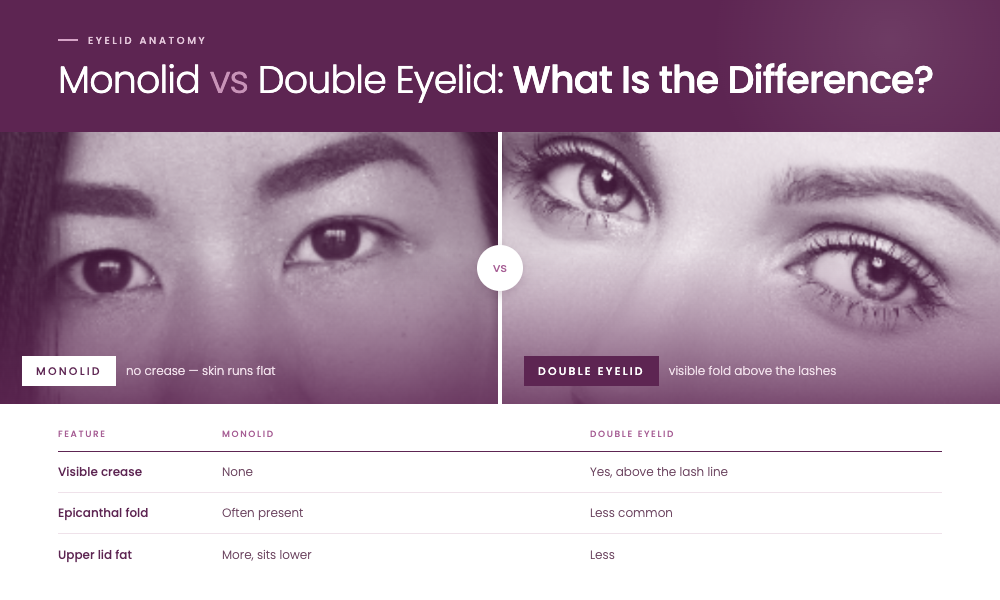
The difference between a monolid and a double eyelid is the crease. A monolid is an upper eyelid with no visible crease, so the skin runs smoothly from the brow to the lashes. A double eyelid has a visible fold above the lash line, which splits the lid into two parts when your eye is open.
Both are normal. Neither is a medical problem. The crease forms because of how the deep lid muscle attaches to the skin, and that attachment is set by your genes.
Key Takeaways
- A monolid has no upper eyelid crease. A double eyelid has one.
- Around half of people of East Asian descent have a monolid. Others can have one too.
- The crease is called the supratarsal crease.
- Monolids are not the same as hooded eyes or a droopy lid.
- Eyelid type is inherited, so it is not caused by tiredness or lifestyle.
- Makeup, tape and glue change the look for a day. Surgery changes the structure.
What Is a Monolid?
A monolid, also called a single eyelid, is an upper lid with no fold. When you open your eye, the skin stays flat. There is no arc between the lash line and the brow.
Many people with a monolid also have an epicanthal fold. That is a small piece of skin that covers the inner corner of the eye near the nose. It is very common and not a defect.
A monolid can make the eye look narrower. Some people like that. Some people want more lid show for makeup. Both views are fine, and neither one needs to be fixed.
What Is a Double Eyelid?
A double eyelid has a crease that sits a few millimetres above the lash line. Doctors call it the supratarsal crease. The lid folds where the levator muscle sends fibres into the skin.
The depth of the crease varies a lot. Some people have a deep, sharp fold. Others have a shallow one that only shows when they look down. That shallow version is sometimes called a hidden crease.
A double eyelid can change with age. As skin loses its stretch, the fold can sit lower or get covered by loose skin. That is a separate matter, and you can read more about it if you want to know what hooded eyes are and what causes them.
Monolid vs Double Eyelid: The Anatomy Behind It
The crease is not about skin thickness alone. It is about where the muscle attaches.

- In a double eyelid, the levator aponeurosis sends fibres forward into the skin. When the muscle lifts the lid, it pulls that skin inward, creating a fold.
- In a monolid, those fibres attach lower down or not at all. So the skin has nothing to pull it in, and it stays flat.
Two more things add to the look:
- Fat. Monolid anatomy often has more fat in the upper lid, which sits lower than it does in a Western lid.
- Palpebral fissure. This is the gap between the upper and lower lids. It tends to be shorter in monolid anatomy so that the eye can look smaller.
None of this is a defect. It is simply a different build. Any eyelid surgery planned for this anatomy needs a surgeon who understands the difference, because a crease designed for a Western lid will look wrong on a monolid face.
Types of Eyelids: A Simple Comparison
| Feature | Monolid | Double eyelid |
| Visible crease | None | Yes, above the lash line |
| Epicanthal fold | Often present | Less common |
| Upper lid fat | More, sits lower | Less |
| Lid show for makeup | Little | More |
| Changes with age | Skin can droop, crease still absent | Crease can drop or hide |
Monolid, Hooded Eyes and Droopy Lids Are Not the Same
This is where most articles get it wrong. Three different things get lumped together, so here is the split.
- Monolid. No crease at all. You were born this way. Nothing has moved or dropped.
- Hooded eyes. You have a crease, but loose skin from the brow area folds over it and hides it. This usually comes with age or weight change.
- Ptosis (droopy lid). The whole lid margin sits too low because the lift muscle is weak. This can block part of your vision.
You can have more than one at once. A person with a monolid can also develop hooded skin in their fifties. That is why a proper check matters before anyone talks about treatment. If you want to know how to qualify for eyelid surgery, the answer depends on which of these three you actually have.
Why Do Some People Have Monolids?
Genetics. That is the short answer.
The double eyelid trait is dominant, and the single eyelid trait is recessive. The double eyelid trait is usually described as dominant, and several genes, not one, set the single-eyelid trait as recessive, but eyelid shape. That is why two parents with creases can still have a child with a monolid. Siblings in the same family can differ. One of your own eyes can even differ from the other.
Monolids are most common in people of East Asian heritage, which includes Korean, Chinese, Japanese, and Mongolian ancestry. They also appear in Native American and Hispanic populations and in people with no Asian ancestry at all.
Some babies born with a monolid develop a crease in the first few years of life. After childhood, a natural crease rarely appears on its own.
Can You Change a Monolid?
Yes, but be clear about what each option really does.
Temporary options
- Eyelid tape or glue gives you a fold for a few hours.
- Makeup uses shadow to make the lid look like it has a crease. The lid itself stays flat.
- Neither one trains the lid. The crease does not become permanent with repeated use.
Surgical options
- A crease can be created with stitches or with a small incision. Doctors call this Asian blepharoplasty, or double eyelid surgery.
- The height of the new crease is planned in millimetres and matched to your face.
- A separate procedure can soften the epicanthal fold. It is not part of the crease surgery.
Any eyelid surgery is a serious medical decision, not a lifestyle purchase. It carries risk, needs recovery time, and results settle over months, not days. A full guide to blepharoplasty covers what the healing period actually involves.
What a Good Result Should Look Like
This is not about making an Asian eye look Western. Good planning keeps you looking like you, with a crease that fits your face shape and lid thickness.
Watch for these signs when you compare clinics:
- Before-and-after photos that show the same person, not a different-looking face.
- A surgeon on the GMC Specialist Register.
- Check that the clinic is registered with the Care Quality Commission.
- An honest talk about risk, and about the option to do nothing.
- No surgery offered to anyone under 18.
A crease set too high or too deep is the classic sign of poor planning. That is very hard to reverse, so surgeon choice matters more than price.
Skin Type Matters Too
If you plan any skin work around the eyes, your skin type changes what is safe.
Darker skin types, which include many Asian, Arabic and Pakistani patients, carry a higher risk of pigment change after traditional CO2 laser. For these skin types, a picosecond laser is the safer route for pigment and melasma concerns. Always ask which device a clinic will use on you and why.
Conclusion
A monolid has no upper eyelid crease, and a double eyelid has one. That single anatomical difference, set by how the levator muscle attaches to your skin, explains everything else people notice about the two eyelid types. Both are normal variations, and neither one needs treatment unless you want a change.
If your lid feels heavy or your vision has narrowed, that is a different matter, and it deserves a medical opinion rather than a beauty one. For a clear assessment of your eyelid anatomy, the specialist team at Dr Tanov Eye & Aesthetics in Newcastle offers consultant-led eyelid consultations.
Frequently Asked Questions
1. What is a mono eyelid?
A mono eyelid, or monolid, is an upper eyelid with no crease. When your eye is open, the skin stays flat all the way from your brow down to your lashes.
2. Is it possible to get double eyelids naturally?
Not usually after childhood. Some infants develop a crease in the first few years of life, but a monolid rarely turns into a double eyelid on its own in adulthood. Tape and glue give a temporary fold, not a permanent one.
3. Are double eyelids a dominant trait?
Broadly, yes. Double eyelids are usually described as a dominant trait, but genetic studies show several genes are involved. Two parents with creases can still have a child with a monolid.
4. What causes double eyelids?
Mostly your genes. The crease forms where the lid muscle attaches to the skin. If that attachment sits high enough, the lid folds there, creating a crease. Age and a droopy lid can change how that crease looks later on.
5. Can double eyelids develop over time?
The crease can change with age. Loose skin may cover it, or it may sit lower than before. But a new crease will not just turn up in an adult. That needs surgery.
6. Are monolids the same as hooded eyes?
No. A monolid has no crease at all. Hooded eyes have a crease that loose skin covers. They look similar from the front but need different treatment.