Early indications of cataracts often seem insignificant. Eyesight appears slightly cloudy. Glare from headlights is stronger than usual. Colours look somewhat washed out. Wearing new glasses temporarily restores sharp vision before they cease to be of help. Most people tend to think of this as age-related or fatigue-induced, which is why it can go undetected for years on end.
Cataract happens when the lens of one’s eye becomes progressively clouded. It develops slowly over time, which is precisely what makes early cataract symptoms hard to detect. This manual provides information on which symptoms to watch for, what your vision might look like with a cataract, and when to have your eyes examined.
Key Takeaways
- The early signs of cataracts develop slowly, so the first changes feel mild and easy to ignore.
- Blurred or cloudy vision, night-time glare and faded colours rank as the most common early warning signs.
- Frequent changes to your glasses prescription often point to a developing cataract.
- A cataract can affect one eye more than the other, so your vision may feel uneven.
- No eye drop reverses a cataract. Surgery remains the only proven treatment.
- A routine eye test can detect cataracts long before your vision worsens.
11 Early Signs of Cataracts
The early signs of cataracts change how you see, not how your eye looks. Nothing hurts. Your eye does not turn red or swell. The changes creep in over months or years, and that slow pace explains why so many people miss them.
Look out for these early cataract symptoms.
1. Misty or Hazy Vision
The lens beneath your pupil is supposed to remain transparent. When proteins in the lens clump together, light scatters rather than focusing on your retina. A mist covers everything that you try to see.
Some people refer to it as seeing through a streaky window or a windshield that never gets wiped clean. There is one thing that tells you all about it: the mist remains constant even if you blink or clean your glasses.
2. Glare from Bright Light
Bright light used to be useful for you. But now it is causing you trouble.
The cloudiness in the lens causes scattered light to fall upon your retina. The bright sunshine, the supermarket lights, and the headlights cause you discomfort now.
3. Poor Night Vision
Often, the ability to see at night will be the first thing affected. There will be less light entering the eye as darkness sets in, and a cloudy lens will further reduce the light reaching the eye.
Driving home in the evening becomes more challenging. Signs will appear later than expected. Some people have stopped driving at night without even realising it could have anything to do with their vision.
4. Halos Around Lights
Looking at a streetlight, you may notice a halo around the light itself. Looking at headlights, you may notice rays coming out from them.
This scattering of light causes these visual phenomena. The best way to see this effect occurs with the light in the darkest part of its surroundings.
5. Faded, Washed-Out Colours
An ageing lens does not only cloud. It yellows.
That yellow tint behaves like a filter sitting in front of everything. Whites drift towards cream. Blues lose their depth. Colours flatten out, rather like an old photograph. The shift happens so gradually that many people only realise how much colour they had lost once the cataract is treated.
6. Frequent Prescription Changes
Your optometrist prescribes glasses for you, and they work great for a while. After a few months, however, they no longer work.
The growing cataract causes changes in the way the lens bends light. This means your prescription continues to change. When you experience two prescription changes one after another, it’s probably an indication.
7. Needing Brighter Light to Read
Your lamp by the chair is too dim for comfort, so you turn on another one.
Since a clouded lens reduces the amount of light reaching the retina, reading requires more light than it previously needed. Small fonts in a dimly lit restaurant are harder to read than large fonts in bright places.

8. Double Vision in One Eye
Double vision usually makes people think of a neurological problem. Confined to one eye, it more often points to the lens.
An uneven cataract splits incoming light into multiple images, so a ghost or shadow appears alongside the real image. Here is the test: cover the other eye – doubling caused by a cataract stays put. Double vision from most other causes disappears.
9. Second Sight
This one catches people out, because it feels like good news. Reading suddenly gets easier.
As the centre of the lens hardens, it bends light more strongly and shifts your focus closer. You may find you can read small print without your reading glasses for the first time in years. The effect does not last. As the cataract develops, the improvement fades, and distance vision usually suffers.
10. Poorer Contrast
Sharpness and contrast are not the same thing. You can still read a letter chart even if you lose the ability to pick out edges.
Kerbs blend into the pavement. The lip of a step vanishes. A pale wall meets a pale floor with no clear line between them. Contrast often fades early, and a standard letter chart may not pick it up at all.
11. Faces Become Harder to Place
You see someone in a crowd but do not immediately recognise them until they come close to you.
Identification of faces depends not on details alone, but also on contrasts. As such, since cataracts reduce contrasts first, faces become indistinct even when letters on charts are easily readable. People will suspect poor memory before their vision before they consider their eyes.
Early symptoms of cataracts do not all appear at once, but in bits. Most people develop two or three before any major problem occurs, and the early signs of cataracts often begin at night. Headlights appear in a star shape. Streetlights have a halo around them. Reading has become more difficult than it was a year ago.
Early Stage Cataract Symptoms vs Later Symptoms
Early stage cataract symptoms stay mild. You still manage daily life. You may simply find that reading a menu in a dim restaurant takes more effort than it used to.
As the lens clouds further, the symptoms sharpen.
| Stage | What you notice |
| Early | Slight haze, more glare at night, colours look flat, glasses need changing often |
| Moderate | Reading and driving get harder, you need brighter light, contrast drops away |
| Advanced | Vision turns clearly misty, everyday tasks become difficult, the pupil may look cloudy |
What Causes Cataracts to Develop?
Ageing causes most cataracts. The lens simply changes as the years pass, and almost everyone eventually develops some degree of clouding.
Several other factors speed the process up:
- Diabetes – high blood sugar alters the structure of the lens
- Smoking– tobacco raises the risk and brings cataracts on earlier
- Long-term steroid use – particularly oral or inhaled steroids taken over many years
- Ultraviolet light – years of strong sun exposure without eye protection
- Eye injury or previous eye surgery – trauma can trigger clouding in one eye
- Family history – cataracts sometimes run in families
- Radiotherapy to the head – treatment can damage the cells that keep the lens clear
What Does Cataract Vision Look Like?
People describe cataract vision in very consistent ways. It rarely looks like darkness or a black patch. It looks like a loss of clarity.
Common descriptions include:
- Looking through a frosted or fogged-up window
- Peering through a dirty windscreen that never wipes clean
- A film or veil sitting over everything you look at
- Colours that seem yellowed, dull or washed out, like an old photograph
- Starbursts and halos spreading out from headlights at night
Two details give cataracts away. First, the haze does not clear when you blink or rub your eyes. Second, both distance and near vision usually soften together, so cleaning your glasses won’t change anything.
Blurred or Cloudy Vision: Which One Do Cataracts Cause?
Both, and they often overlap. Blurred or cloudy vision from cataracts tends to start subtly and build. Blur softens edges and text. Cloudiness dulls contrast and drains the brightness out of a scene.
Blurred or cloudy vision does not automatically mean a cataract, though. Dry eye, an out-of-date prescription and other retinal conditions produce similar effects. Only an eye examination separates them.
How to Tell If You Have Cataracts?
You cannot diagnose a cataract at home, and you usually cannot see one in the mirror. Learning how to tell if you have cataracts starts with tracking the pattern of your symptoms, then confirming that pattern with an eye test.
The early signs of cataracts follow a recognisable shape. These clues point strongly towards one:
- Your vision gradually fogs over months rather than days.
- Bright light makes seeing harder, not easier.
- Your glasses stop working, even after a recent prescription update.
- Night driving feels worse than daytime driving.
- Colours look flatter than other people describe them.
- Nothing hurts, and your eye looks normal.
Sudden vision loss works differently. It does not fit the cataract pattern and needs urgent assessment, because other conditions may be causing it.
How Doctors Diagnose Cataracts
Diagnosis is quick, painless and straightforward.
An optometrist or ophthalmologist runs a short series of checks:
- Visual acuity test – reading a letter chart to measure how much sharpness you have lost
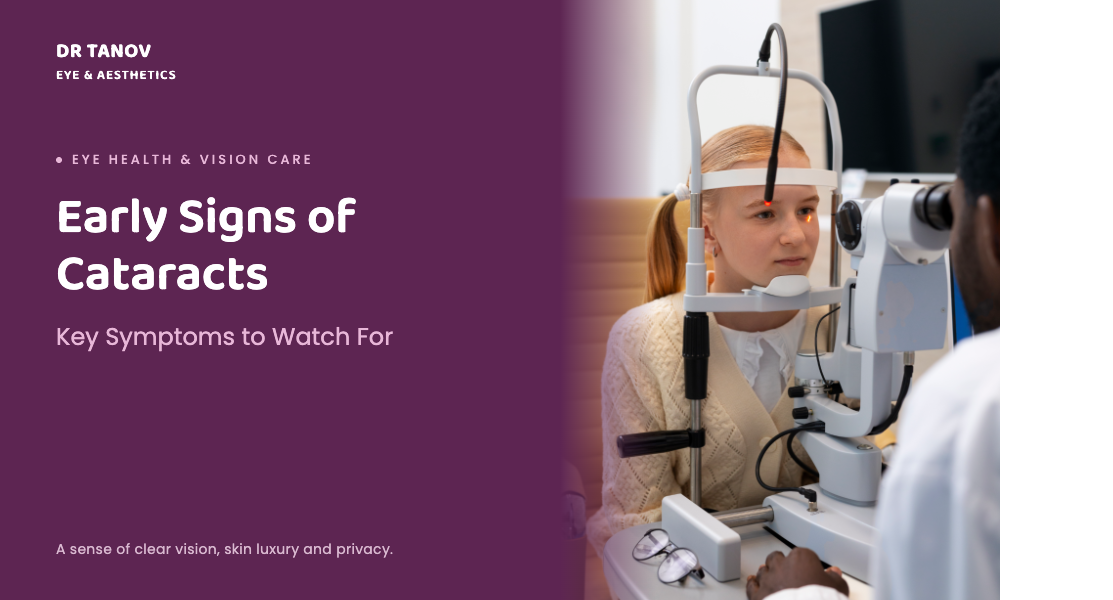
- Slit-lamp examination – a bright, magnified light lets the clinician look directly at the lens and grade the clouding
- Retinal dilation exam – the pupils are dilated to examine the retina and the optic nerve as well
- Testing for glare and contrast sensitivity – measures the symptoms that cannot be determined using only a letter chart
The above information is significant. Some people can read a letter chart well in low-light conditions but cannot cope with glare when driving.
Treatment Options for Cataracts
Treatment depends entirely on how much the cataract affects your daily life, not on your age.
Early cataracts
While the clouding stays mild, simple measures help for a time:
- A stronger or updated glasses prescription
- Brighter, better-positioned reading lights
- Anti-glare lens coatings
- Sunglasses and a brimmed hat in strong light
These steps manage the symptoms. They do not slow the cataract down or clear it.
Cataract surgery
However, cataracts form in both eyes, but very rarely at the same rate. The one that clouds up faster makes you see poorly out of that particular eye. The healthy eye will compensate for that, and so you won’t realise anything has gone wrong until you block that particular eye.
Key points about the procedure:
- Numbing drops provide the anaesthetic, so no general anaesthetic is needed
- It runs as a day case, and most patients go home the same day
- The procedure itself typically takes around 30 to 45 minutes
- Most people rest for a few days and return to their normal routine within one to two weeks
- A cataract does not need to be ripe before it can be removed
Lens choice shapes the result, and each option involves a trade-off:
- Monofocal lenses give the sharpest vision at a single distance, with the lowest risk of halos. Reading glasses are usually still needed.
- Toric lenses correct astigmatism alongside the cataract.
- EDOF (extended depth of focus) lenses support distance and intermediate vision, which suits drivers and screen users.
- Trifocal or multifocal lenses aim to cover near, intermediate and distance vision, but carry a higher chance of halos at night.
- Light adjustable lenses allow fine-tuning of the focus after surgery.
Like any operation, cataract surgery carries risks. They are uncommon, but they include infection, swelling and posterior capsule opacification, a clouding of the membrane behind the lens implant that can appear months or years later. A short laser treatment clears that if it happens.
When Should You Book an Eye Test?
Book an eye test if any of these apply:
- Your vision has turned hazy or misty over recent months
- Night driving has become uncomfortable, or you now avoid it
- Glare from headlights or sunlight bothers you more than before
- Your glasses prescription has changed more than once in a short period
- Colours look faded compared with how others describe them
Adults should have a routine eye test at least every two years anyway, and more often after 60 or if they have diabetes. The early signs of cataracts show up on those tests long before your sight causes real trouble.
Conclusion
Symptoms of cataracts can be easily overlooked because they include blurry or cloudy vision, sensitivity to glare, halos at night, dullness of colours, and poor vision in your glasses. There’s no pain,n and there are no visible changes, and that’s precisely why symptoms can be overlooked. One simple eye test will reveal the problem.
If your vision has changed and you want a clear answer, the team at Dr Tanov Eye & Aesthetics offers consultant-led eye assessments and cataract surgery and lens replacement in London and Newcastle, with Dr Kalin Tanov, Consultant Ophthalmic Surgeon, at every stage.
Frequently Asked Questions
At what age do cataracts usually start?
Age-related cataracts usually develop after age 50 but do not typically cause symptoms until around 65. However, some may start developing before 65 due to other conditions like diabetes, excessive smoking, history of using steroids for an extended period of time, or prior damage to the eyes.
How quickly do cataracts get worse?
The rate at which the disease develops varies widely. Some take many years even to show minor changes, while others start causing problems within a few months.
Can eye drops cure cataracts?
No. No eye drop, supplement or vitamin reverses a cataract or reliably slows one down. Surgery to replace the cloudy lens is the only proven treatment.
Can you still drive with early cataracts?
Often, yes, provided your vision still meets the DVLA standard. You must be able to read a number plate from 20 metres and meet the required visual acuity. Tell the DVLA if your eyesight falls below that standard. Many people with early cataracts choose to avoid night driving first.
Are cataracts painful?
No. Cataracts do not cause pain, redness or irritation. Eye pain points to a different problem and needs prompt assessment.
Can cataracts come back after surgery?
The cataract itself cannot return, because the natural lens has been removed. Some people develop posterior capsule opacification, where the membrane behind the lens implant clouds over. A short outpatient laser treatment clears it.
Do all cataracts need surgery?
No. Surgery becomes worth considering once the cataract interferes with things you need to do, such as reading, working or driving. If your symptoms stay mild, monitoring at your regular eye test is a reasonable choice.