
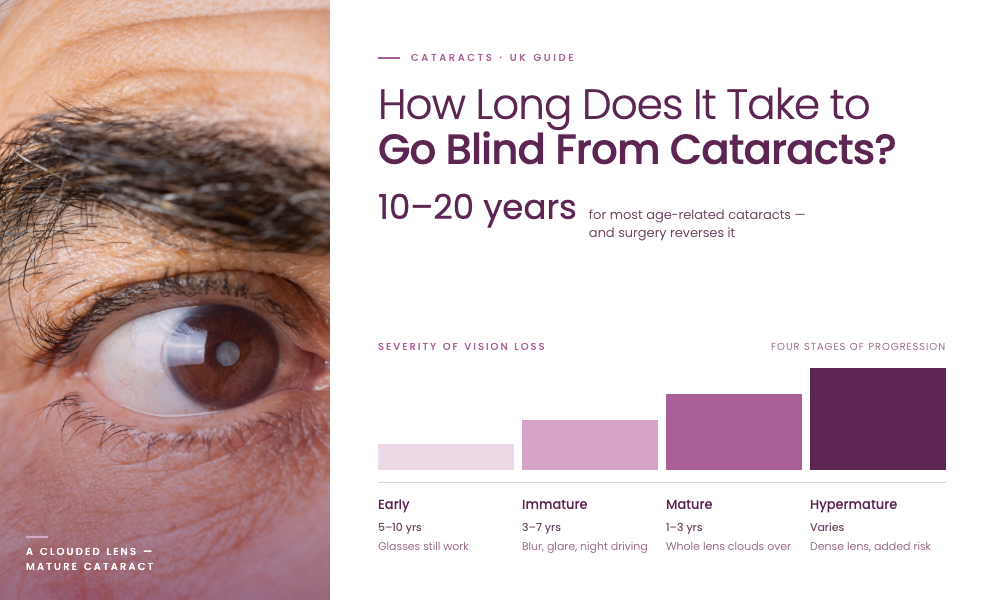
Most people take 10 to 20 years to go blind from cataracts, and many never reach that point at all. Age-related cataracts grow slowly. Your sight fades in small steps over years, not weeks. Some types are quicker. Even so, total sight loss is rare in the UK, because surgery is easy to get.
The more useful question is not how long it takes. It is what happens along the way, and when treatment makes sense. Cataract blindness is also the one form of sight loss that surgery can reverse. Once a surgeon removes the cloudy lens, your vision comes back.
Key Takeaways
- Age-related cataracts usually take 10 to 20 years to cause severe sight loss.
- Total blindness from cataracts is rare in the UK because treatment is available.
- Cataracts pass through four stages, and each stage lasts a different length of time.
- Some cataracts move much faster, sometimes within one or two years
- UK law defines sight loss by measured vision, not by how your eyes look
- Surgery reverses cataract sight loss, unlike most other eye conditions
How Long Does It Take to Go Blind From Cataracts?
For a typical age-related cataract, severe sight loss takes 10 to 20 years from the first lens changes. That figure covers the whole journey, from the point a surgeon can first spot the cataract to the point where you can no longer read or recognise faces.
The time it takes each person to develop it varies with their age and general health. Cataract types also have their own influence. Even two people diagnosed on the same day might end up taking different periods of time. It is just a ballpark number.
Here is how the years usually break down.
| Stage | How long it lasts | What your vision does |
| Early | 5 to 10 years | Glasses still work |
| Immature | 3 to 7 years | Blur, glare, poor night vision |
| Mature | 1 to 3 years | The whole lens clouds. Severe loss |
| Hypermature | Varies | Dense lens. Risk of other problems |
The early stage takes the longest and troubles you the least. Most people reach a surgeon during the immature stage, because that is when daily tasks start to suffer.
What Blindness Actually Means in the UK
Most people associate blindness with darkness. The meaning of UK law is more limited than that. It establishes a precise level of vision. Plenty of people who meet it still see light, shape, and movement.
In the UK, a consultant ophthalmologist can sign a Certificate of Vision Impairment. That certificate places you in one of two groups.
- Sight impaired, once your vision falls to roughly 6/60 with glasses on
- Severely sight impaired, once your vision falls below 3/60, or below 6/60 with a reduced field of view
A 6/60 result means you see at six metres what someone with normal sight sees at 60 metres. Even at that level, most people with cataracts still notice light and shape. Complete loss of light perception rarely happens from a cataract alone.
Driving has a separate standard. You must read a number plate from 20 metres. You must also tell the DVLA once cataracts affect both eyes, regardless of your test result.
The Stages of Cataract Progression
Cataracts do not jump straight to sight loss. They pass through four clear stages, and a surgeon can tell you which one you are in after a slit lamp examination.

Early stage. Protein clumps form inside the lens. You may notice nothing at all. A routine eye test often picks this up before you do.
Immature stage. The cloudy area spreads. Colours look duller. Headlights throw more glare at night. Your prescription changes more often than it used to, and each new pair of glasses helps a bit less.
Mature stage. The whole lens turns cloudy. Vision drops sharply. Reading, driving, and faces all become hard work. Most surgeons treat well before this point.
Hypermature stage. The lens hardens and may leak protein. This stage raises eye pressure and makes surgery more complex. It is uncommon in the UK.
What Is a Mature Cataract?
A mature cataract means the cloudiness has spread across the whole lens. Very little light gets through. Your vision drops to a point where glasses no longer help. Surgery still works at this stage, but the lens is denser, and the operation takes more care.
Can Cataracts Cause Blindness?
Yes, but only if they go untreated. Cataracts continue to be the main cause of blindness in the world, mainly due to limited access to surgical procedures. However, in the UK, this situation is very different, as cataract treatment is considered routine in the NHS and private practices.
So yes, cataracts can cause blindness. It just rarely happens here. The risk falls on people who go years without an eye test, or who put off treatment once a surgeon has recommended it.
What Happens If Cataracts Are Left Untreated?
An untreated cataract does not stay still. The lens keeps clouding over, and the effects keep stacking up.
- Glasses are no longer useful.
- Driving at night becomes dangerous due to headlight glare.
- You are more likely to trip, fall, and break something
- Surgery gets harder once the lens hardens
- Independence slips away, which often leads to isolation
The last two points matter most. A cataract removed at the immature stage is a routine 15-minute operation. The same cataract left for another decade sits inside a rigid lens with a weaker capsule, and the risk of complications rises.
How Long Can You Leave Cataracts Untreated?
There is no fixed deadline, and no reason to rush the day after diagnosis. Plenty of people live with an early cataract for years and manage well with brighter lamps and an updated prescription.
Judge it by what you can do, not by how long it has been. Once the cataract stops you doing something you need to do, you have waited long enough. Common triggers include night driving, reading small print, and recognising faces across a room.
Waiting past that point buys you nothing. Your vision will not recover on its own, and the operation will not get easier.
Is Blindness From Cataracts Reversible?
Yes. A cataract clouds the natural lens. Surgery removes that lens and replaces it with a clear artificial one. Nothing about the retina or optic nerve has been damaged, so the sight comes back once light can reach the back of the eye again.
That sets cataracts apart from glaucoma and macular degeneration, where lost vision does not return. It also means a person registered as severely sight impaired because of cataracts can come off that register after surgery.
Two points to keep in mind. Recovery depends on the rest of the eye being healthy, which is why a full assessment checks for other eye conditions first. And dense, long-standing cataracts carry a slightly higher risk of complications, so results vary more at that end.
What Makes Cataracts Move Faster
Not every cataract follows the 10- to 20-year path. Several things shorten it.
- Cataract type. Posterior subcapsular cataracts can reach your vision within a year or two.
- Diabetes. Long-term high blood sugar approximately doubles the risk. It also increases the rate of formation.
- Steroids. Long-term use, including eye drops and inhalers, may result in changes within several months.
- Eye Injury. A traumatic cataract can form in a few weeks.
- Smoking. This association is dose-dependent and therefore more changes occur in heavy smokers.
- Ultraviolet Light Exposure. Cumulative effects of sun exposure over years.
If any of these apply to you, book eye tests more often than the standard two-year gap.
Conclusion: How long does it take to go blind from cataracts?
For most people, it takes 10 to 20 years, and only if nobody treats the cataract along the way. Faster types exist, but they are the exception rather than the rule.
Your stage matters more than the calendar does. Book an assessment once the cloudiness starts to affect your driving or your reading. Surgery restores sight in most cases, unlike any other common eye condition.
If you want a clear answer about your own eyes, Dr Kalin Tanov and the team at Dr Tanov Eye & Aesthetics provide consultant-led cataract assessment in London and Newcastle, with your stage, your risk, and your options explained in plain terms.
Frequently Asked Questions
Can you go blind from cataracts overnight?
No. A cataract clouds the lens slowly, over months and years. If your sight drops suddenly, something else is behind it. That could be a retinal detachment or a blocked blood vessel and needs same-day attention from an eye casualty department.
How fast do cataracts progress?
Slowly, for most people. A noticeable change usually takes 12 to 24 months. Cataracts caused by diabetes, steroids, or an eye injury move much faster, sometimes within a few months.
At what stage should cataracts be removed?
There is no set stage. UK practice is to remove a cataract once it interferes with daily life, such as driving, reading, or work. You do not need to wait for the cataract to become mature.
Do cataracts always lead to blindness?
No. Left completely untreated, most would eventually cause severe sight loss. In practice, almost nobody in the UK reaches that point because surgery is available both on the NHS and privately.
Can cataracts be reversed without surgery?
No. Drops, supplements, and eye exercises do nothing to a cataract. Stronger glasses and brighter lighting help in the early stages, but surgery is the only treatment that removes the cloudiness.
Can you drive with cataracts?
You can drive as long as you still meet the standard, which means you can read a number plate from 20 metres. You must tell the DVLA once cataracts affect both eyes. Many people stop driving at night well before they fail the test.