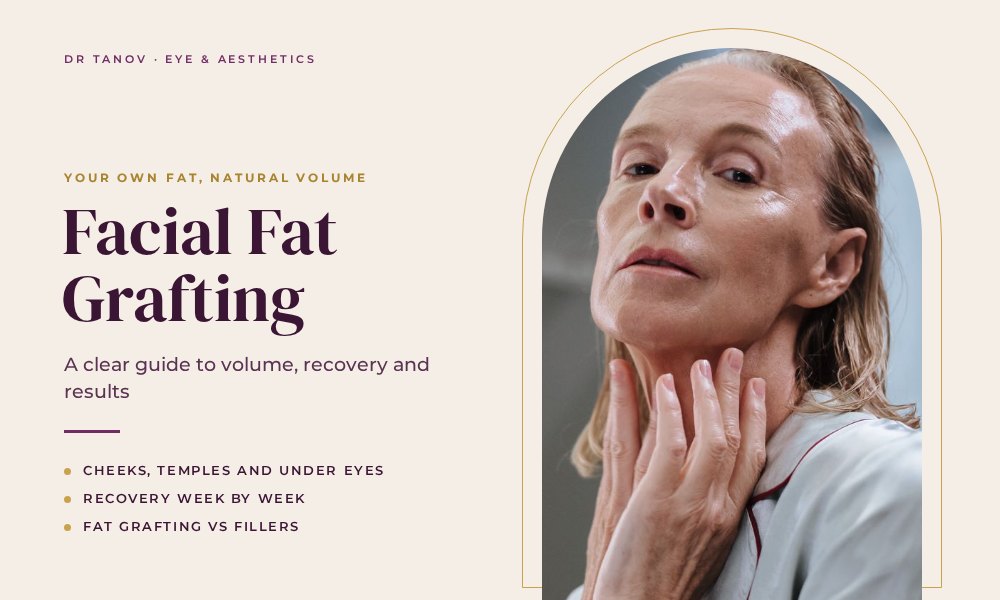
Facial fat grafting moves a small amount of your own fat to parts of your face that have lost volume. A doctor takes the fat from an area such as your tummy or thighs, cleans it, and places it in tiny amounts under the skin. The aim is soft, natural fullness in areas like the cheeks, temples and under the eyes.
However, fat grafting is not a facelift. It adds volume, but it does not lift loose, heavy skin. So it works best when your main concern is lost volume rather than sagging.
This guide explains how facial fat transfer works, who it suits, recovery, risks and how it compares with fillers.
Key Takeaways
- Facial fat grafting uses your own fat to restore lost volume in the face
- It adds volume but does not lift loose skin, so it is not a facelift
- Around 50 to 70% of the grafted fat usually survives, so some people need a top-up
- Bruises often fade within days to a couple of weeks, but you judge the final result at three to six months
- Unlike filler, you can’t dissolve fat, so careful planning matters
What Is Facial Fat Grafting?
Facial fat grafting is also called facial fat transfer or lipofilling. ‘Grafting’ simply means moving living tissue from one part of your body to another. In this case, the tissue is fat.
As you age, your face loses fat, and the bone underneath slowly changes shape. So your cheeks flatten, your temples hollow, and your lines deepen. Fat grafting replaces some of that lost volume with your own tissue.
Because the fat is your own, it is not a foreign product. However, that does not make it risk-free.
Micro Fat vs Nano Fat: What Is the Difference?
Micro Fat
Micro fat is fat in very small pieces. It adds soft volume, so doctors use it for hollow cheeks, temples, deep smile lines and the jawline.
Nano Fat
Nano fat is filtered much more finely, until it is almost a liquid. It adds very little volume. Instead, doctors place it close to the surface to help thin or dull skin, such as crepey skin under the eyes. However, research on nano fat is still in the early stages.
Some clinics filter the fat in a sealed device, such as LipoCube or NanoCube. Many plans use both types: micro fat for volume and nano fat for skin quality.
Who Is Facial Fat Grafting Right For?
You may suit facial fat grafting if you:
- Have lost volume in your cheeks, temples or under your eyes
- Want a longer-lasting option that uses your own tissue
- Have enough spare fat to collect, often from the tummy or outer thighs
- Have a stable weight
- Are 18 or over and in good general health
Who May Need a Different Option
Fat grafting may not suit you if you:
- Smoke and can’t stop around the time of treatment, because smoking reduces blood flow to the new fat
- Mainly have loose, heavy skin that needs lifting
- Have puffy eye bags, as extra volume can make a bulge look bigger
- Are pregnant or breastfeeding
- Have an active skin infection, a bleeding problem or a condition that slows healing
- Want an exact or instant result
If you take blood thinners or have a long-term health condition, tell your doctor first. You may need advice from your GP or specialist.

Not sure if fat grafting suits your face? A careful check of your volume loss, skin and facial structure. Honest advice on fat grafting, filler or another option. A plan that matches your goals and your anatomy.
Which Face Areas Can Fat Grafting Treat?
Fat grafting can treat one or several areas in a session. Common areas include:
- Cheeks: restores fullness to flat or hollow cheeks
- Temples: softens a sunken look at the sides of the forehead
- Nasolabial lines: softens the lines that run from your nose to the corners of your mouth
- Lips: adds gentle, natural fullness
- Chin and jawline: improves shape and balance in the lower face
- Under the eyes: fills tear trough hollows, often with nano fat for thin skin
The tear trough is the groove between your lower eyelid and cheek. Our guide to fat grafting under the eyes covers it in depth. If you are not sure whether your shadows come from hollows, pigment or veins, read about the types of dark circles.
How Does the Procedure Work, Step by Step?
Facial fat grafting usually takes place under local anaesthetic. This means you stay awake, but the treated areas are numb. A full-face session often takes two to four hours.
- Plan the result. Your doctor examines your face, marks the areas that need volume and chooses a donor site.
- Numb the areas. Local anaesthetic numbs the donor site and your face.
- Collect the fat. A cannula, which is a thin, blunt tube, removes fat through a cut about half a centimetre long. The fat often comes from the outer thighs or tummy.
- Prepare the fat. The fat is filtered to separate it from blood and fluid. It is then prepared as microfat, nanofat or both.
- Place the fat. Your doctor injects tiny amounts in thin layers with a fine cannula. This helps more of the fat survive and keeps the result smooth.
Fat Grafting vs Dermal Fillers: How Do They Compare?
Dermal fillers are gels, most often made of hyaluronic acid, that a doctor injects to add volume. Both treatments restore volume. However, they differ in how long they last and whether you can undo them.
| Facial fat grafting | Hyaluronic acid fillers | |
|---|---|---|
| What it is | Your own fat moved to the face | A gel injected under the skin |
| Anaesthetic | Local anaesthetic | Numbing cream, or none |
| Treatment time | Often two to four hours for the full face | Often 30 to 60 minutes |
| Recovery | Bruises and swelling for days to a couple of weeks | Often little or no time off |
| How long it lasts | Fat that survives can last for years | Often several months to over a year |
| Can it be reversed? | No, you can’t dissolve fat | Yes, an enzyme can dissolve most fillers |
| Main risks | Lumps, uneven fat survival, rare blood vessel blockage | Lumps, swelling, rare blood vessel blockage |
Neither option is better for everyone. Filler suits a quick, reversible trial of volume. Fat grafting suits you if you want longer-lasting results and can accept a longer recovery.
What Is Recovery Like After Facial Fat Grafting?
Recovery varies depending on how many areas you treat. Here is a general guide:
- Days 1 to 3: swelling and bruising peak. Cold packs and sleeping with your head elevated help. Avoid showers for the first two days, or follow your clinic’s advice.
- Week 1: much of the swelling settles. Some bruises fade in days, others take longer.
- Weeks 2 to 3: most bruises fade. Avoid hard exercise, saunas and pressure on your face.
- Months 1 to 3: the last swelling goes, and the result appears.
- Months 3 to 6: the fat that will stay has settled. This is when you judge the final volume.
Your clinic may prescribe antibiotics, often for about three days. Contact the clinic straight away if you notice severe pain, worsening swelling, a fever or signs of infection.
How Long Do Facial Fat Grafting Results Last?
Fat needs a new blood supply to survive. Some does not get one, so your body clears it over the first few months. Typically, around 50 to 70% of the grafted fat stays. However, this varies. Your health and whether you smoke both play a part.
The fat that survives behaves like the rest of your body fat. So if you gain or lose a lot of weight, the treated areas can change too. Your face also keeps ageing. That’s why results are long-lasting, not permanent.
To see how results develop over time and how to judge photos fairly, read our guide to fat transfer face before and after.
What Are the Risks of Facial Fat Grafting?
Every procedure carries some risk. Most side effects are mild and settle on their own.
Common Side Effects
- Swelling and bruising on the face and at the donor site
- A slightly uneven look while the swelling settles
Less Common Risks
- Lumps or small bumps under the skin
- Uneven fat survival between the two sides
- Fat cysts, which are small, firm pockets of fat under the skin
- Infection in the face or at the donor site
People sometimes call an overfilled or uneven result botched fat grafting. Careful planning and small amounts placed in thin layers lower this risk.
Rare but Serious Risks
In rare cases, fat can enter a blood vessel and block blood flow. Around the eyes and nose, this can affect the eye or brain and cause vision loss or a stroke. These events are very rare. Still, they are why you should choose a doctor who knows the anatomy of the face and eye socket well. Near the eyes, an eye surgeon’s knowledge of the local blood vessels matters.
Get urgent medical help at A&E or by calling 999 if you notice any change in your vision, sudden severe pain, or patches of skin that turn white or blue-grey after treatment.
Ready to restore lost volume with your own fat? Facial fat grafting offered at our Newcastle clinic. Clear guidance on recovery, results and top-ups. Honest advice if another option suits you better.
When Should You Choose Another Option?
Fat grafting is not the answer for every face. Another option may suit you better:
- Dermal fillers, if you want a reversible trial of volume first
- Surgery, such as a facelift or eyelid surgery, if loose, heavy skin is the main problem
- Skin treatments, such as Morpheus8, if your main concern is skin quality or mild laxity rather than volume
For example, puffy eye bags often need surgery rather than volume. Our guide on how to get rid of eye bags explains those options.
Conclusion
Facial fat grafting uses your own fat to restore lost volume in the cheeks, temples, lips, jawline and under the eyes. It can give soft, long-lasting results. However, it does not lift loose skin, not all the fat survives, and you can’t reverse it. So the right choice starts with an honest assessment.
At Dr Tanov Eye & Aesthetics, we offer full face fat grafting at our Newcastle clinic. Dr Kalin Tanov, a Consultant Ophthalmic Surgeon with over a decade of experience, can assess the cause of your volume loss and advise whether fat grafting suits you. For more detail, read our guides to fat grafting under the eyes and fat transfer face before and after.
Frequently Asked Questions
Is facial fat grafting permanent?
Not exactly. The fat that survives can last for years. However, your face keeps ageing, and weight changes affect the result. So it is long-lasting, not permanent.
Is fat grafting better than fillers?
Neither is better for everyone. Fat grafting lasts longer, but recovery takes longer, and you can’t reverse it. Fillers are quicker and reversible, but you need repeat treatments.
Does facial fat grafting hurt?
Local anaesthetic numbs the areas, so you should feel only pressure or pulling. Afterwards, your face and donor site may feel sore for a few days.
How much does facial fat transfer cost in the UK?
The cost depends on how many areas you treat. So your price is confirmed at your consultation. Consultation fees are usually separate and may be non-refundable.
How much fat survives after facial fat grafting?
Around 50 to 70% of the grafted fat usually survives. Your body absorbs the rest over the first few months. That’s why some people need a top-up.
Can botched fat grafting on the face be fixed?
Sometimes. Small lumps may soften with time or need treatment. Too much fat is harder to correct, because you can’t dissolve it like filler. That’s why modest amounts matter from the start.
When can you return to work after facial fat grafting?
Many people return to desk work within one to two weeks, once the bruising fades. Avoid hard exercise for the first couple of weeks, or as your clinic advises.