No, you cannot have cataract surgery twice on the same eye. Once the cloudy natural lens is removed and replaced with an artificial lens, no lens remains to remove. The cataract cannot form again.
Still, plenty of people need more treatment later. Vision can turn cloudy again years after surgery, and that is normal. Usually, a thin membrane forms behind the lens, not a new cataract. Other patients need work on the second eye, or a small correction if their vision is not as sharp as they hoped. This guide explains each situation in plain terms.
Key Takeaways
- A cataract cannot come back once the natural lens is removed.
- Cloudy vision months or years later is usually posterior capsule opacification, treated with a quick laser.
- Each eye is treated separately, so most people have two operations.
- In rare cases, a lens can be swapped in, but this is a different procedure than cataract surgery.
- An eye specialist should check any new change in vision after surgery.
Can Cataract Surgery Be Done Again on the Same Eye?
No. The surgery removes the cloudy lens for good. A new lens takes its place. It is made of clear plastic, and it stays in your eye for life. That plastic lens cannot turn cloudy the way a natural lens does.
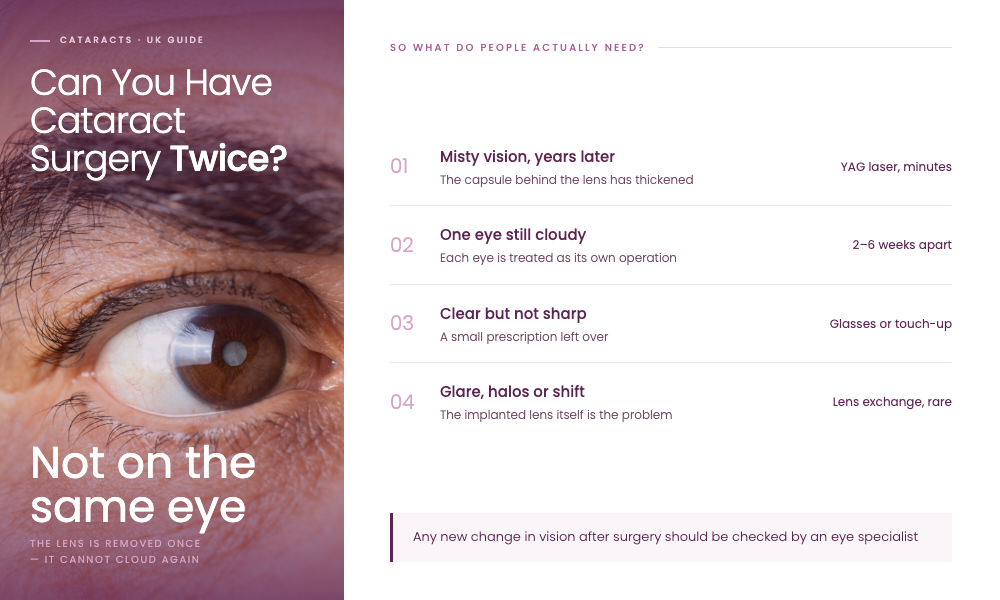
So when someone asks about a repeat cataract surgery, they usually mean one of four things:
- Vision has turned cloudy again
- The second eye still needs treatment
- The vision is clear but not sharp enough
- The lens itself is causing a problem
Each one has a different answer. The table below sorts them out.
| What you notice | Likely cause | Usual treatment |
| Cloudy or misty vision months or years later | Thickened capsule behind the lens | YAG laser, a few minutes, no cut |
| One eye clear, one eye still cloudy | Second eye cataract | Surgery on the second eye |
| Clear but blurry at some distances | Small leftover prescription | Glasses, contacts, or a laser touch-up |
| Glare, halos, or a lens out of place | Lens problem | Lens exchange, rarely needed |
Read More: How long does it take to go blind from cataracts
Why Cataracts Do Not Come Back
A cataract forms when proteins inside your natural lens clump together. That clump blocks light and dims your sight.
Surgery takes that whole lens away. The artificial lens has no proteins, so that nothing can clump. This is why surgeons say the eye only needs one cataract operation in a lifetime.
If your sight dips later, something else has changed. That does not mean the first operation failed.
The Real Reason Vision Turns Cloudy Again
The most common cause is posterior capsule opacification, sometimes called a secondary cataract. It is not a true cataract.

During surgery, the surgeon keeps a thin, clear bag in place to hold the new lens. Over time, cells can grow across the back of that bag. The bag thickens and light scatters again. Your sight may seem misty, or lights may glare at night.
Treatment is a laser called a YAG capsulotomy. It takes only a few minutes, needs no cut, and you go home the same day. Most people notice sharper sight within a day or two. If you want to know more about whether cataracts come back and how the laser works, our blog covers both topics in detail.
How Long Between Cataract Surgery on Each Eye?
Most people have cataracts in both eyes. Surgeons treat one eye at a time, so two operations in total is normal. That is not a repeat of the same surgery.
In the UK, the usual gap is around two to six weeks. The first eye needs time to settle so the surgeon can check the result before booking the second eye.
Your own gap depends on a few things:
- How well the first eye heals
- How much the untreated eye affects daily life
- Whether both eyes need different lens powers
- Your general health and any other eye conditions
Some private centres offer both eyes on the same day. This is called immediate sequential bilateral cataract surgery. It suits only carefully chosen patients, and it is rare on the NHS. Your surgeon will tell you if you are suitable.
The gap between eyes can feel odd. One eye sees clearly, and the other does not. Your old glasses may not work well for a short while. This settles once the second eye is done.
When a Lens Exchange Is Considered
An intraocular lens exchange means removing the artificial lens and inserting a new one. It is not the same as cataract surgery because the natural lens has already been removed.
It is uncommon. Most people keep their first lens for life. A surgeon may discuss an exchange if:
- The lens power does not match the eye, and glasses cannot fix the gap
- The lens has shifted out of place
- Glare, halos or shadows continue and do not settle
- A toric lens for astigmatism has rotated
An exchange is more complex than the first operation. Scar tissue can form around the lens, so the surgeon must work carefully. That is why any decision here follows a full assessment, not a quick chat.
Laser Touch Up After Cataract Surgery
Sometimes vision is clear but not quite sharp. This is called residual refractive error. It happens when the lens power ends up slightly off target.
The eye is measured carefully before surgery, but no measurement is perfect. Small gaps do occur.
Options include:
- Glasses or contact lenses for the small difference
- A laser correction on the surface of the eye, sometimes called a touch-up
- A lens exchange, only when the gap is large
Most people never need any of these. Your surgeon will wait until the eye has fully settled before discussing any correction, which usually takes about three months.
When to See an Eye Specialist
After cataract surgery, schedule a checkup if you observe any of these:
- Your sight turns misty or dull again
- Glare at night, or rings of light around headlamps and lamps
- Flashes or floaters appear out of nowhere
- A curtain or shadow across your vision
- Pain or redness that does not settle
Sudden floaters, flashes or a shadow need urgent attention. These can signal a retinal problem and should be checked straight away.
Conclusion: So, can you have cataract surgery twice?
Not in the same eye. The cloudy lens is taken out once, and it cannot grow back. Other things can happen, though. The capsule behind your new lens may thicken. Your second eye may still need treatment. Your sight may need a small tweak later. Each has a simple fix, and none of it means the first operation failed.
If your sight has changed after cataract surgery, get it checked rather than guess the cause. Dr Tanov and the team at Dr Tanov Eyes and Aesthetics offer consultant-led cataract care in Newcastle and at Harley Street in London, with a clear explanation of what is happening in your eye and what, if anything, needs treatment.
Frequently Asked Questions
1. Can cataracts grow back after surgery?
No. A cataract cannot develop again since you have lost your normal lens. If vision becomes blurry later, the capsule beneath the new lens is typically the cause. A quick laser clears it.
2. How many times can you have cataract surgery?
Once per eye; most people have two operations in total, one for each eye. Further procedures are different treatments, not repeat cataract surgery.
3. Can a cataract lens be replaced more than once?
Yes, but it is rare. A lens exchange is possible if the lens causes real problems. Each extra procedure is more complex, so surgeons weigh the benefit carefully.
4. What is a secondary cataract?
It is the common name for posterior capsule opacification. Cells grow across the clear bag that holds your new lens, so light scatters. A YAG laser clears it.
5. How long after cataract surgery can you have YAG laser?
There is no fixed date. The laser is used once the eye has settled and once the capsule is clearly the cause of the blur. Some people need it months later, some years later, and many never need it.
6. Can you have cataract surgery on both eyes at once?
Yes, in selected cases. Same-day surgery on both eyes is offered at some private centres. It is not standard on the NHS, and it suits only patients who meet strict safety criteria.